Your dry-cleaning customer rushes in on a Friday, drops off a suit and three shirts, takes the little paper ticket, promises to collect “Tuesday-ish”, and then vanishes into the fog of modern life. The clothes are pressed and bagged by Monday. They sit on the rail, and they wait…. And wait…. Meanwhile you are making the daily ring-round, the ticket is lost somewhere in a coat pocket, and that lovely customer does not come back for another six months because, honestly, they forgot you existed the moment they walked out.
That gap between drop-off and collection is where dry cleaners leak money. Not dramatically. Just a slow drip of forgotten orders, uncollected garments taking up rail space, and perfectly happy customers who never become regulars because nothing ever reminds them you are there.
A branded dry cleaning app fixes that drip. Not an app you need a developer and a second mortgage for, but one you build yourself on AppBuild.diy in roughly the time it takes to steam a wedding dress. Let us talk about why that matters, and how it works in the real world of starch, plastic bags and the eternal mystery of the missing left glove.
Why do dry cleaners lose customers between the counter and the collection?
Because the entire relationship currently depends on a scrap of paper and the customer’s memory. Both are unreliable.
The UK dry cleaning and cleaning services sector is worth around £1.6 billion in 2026, with the number of businesses up 2.3% to roughly 4,829, according to IBISWorld. That is a healthy, growing market, which also means your customer has three other shops within walking distance. If you are not the one they remember, you are the one they replace.
The trouble is, dry cleaning is a “need it, forget it” purchase. People think about you precisely twice: when they have a stain, and when they have an event. The rest of the time, you are invisible to them. An app flips that. It puts your shop on the one screen your customer checks a hundred times a day, so you stay in their pocket between the suit emergency and the Christmas party.
How does a dry cleaners app end the “is it ready yet?” phone chaos?
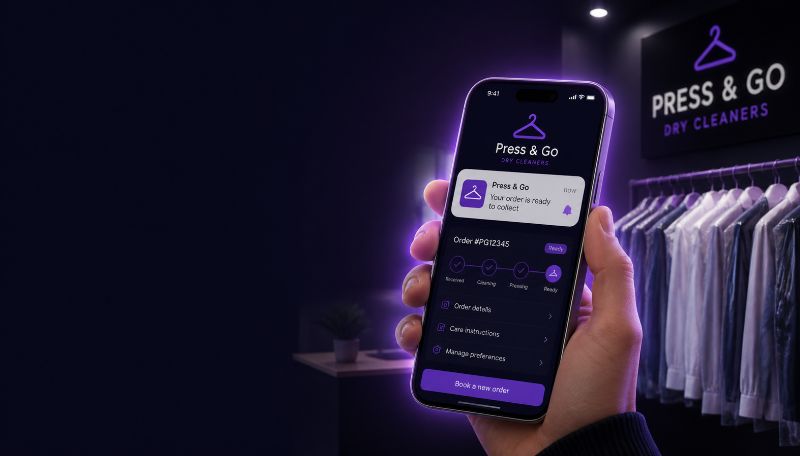
With one lovely little feature: push notifications. The moment an order is pressed, bagged and on the rail, you send a push that says “Your order is ready to collect.” No phone call. No waiting on hold. No front-desk assistant tied up explaining that yes, the curtains will be a few more days.
Here is the part that makes finance directors smile. On AppBuild.diy, push notifications are unlimited and free. There are no per-message fees, ever. Text-message reminders cost you money every single time you press send, which is why most shops ration them. Push does not. You can send a “ready to collect” to every customer, every day, and it costs you nothing. And people genuinely notice them: average push notification open rates sit around 20%, well ahead of email in every industry measured, according to benchmarks collected by MobiLoud.
That one feature alone ends the daily ring-round, clears your rail of forgotten orders faster, and makes you look wildly more organised than the shop down the road still scribbling on carbon-paper tickets.
“The dry cleaners who win the next decade will not be the ones with the best presses, they will be the ones who never let a customer forget them,” says Ian Naylor, Founder of AppBuild.diy. “A free push notification is the cheapest, most powerful marketing a local shop has ever had access to, and almost nobody in this trade is using it yet.”
Can an app really smooth out the feast-or-famine swing?
Yes, and this is where it earns its keep. Dry cleaning runs in waves: party season, wedding season, back-to-the-office January, and then long flat stretches where the rail goes quiet and you are wondering why you bothered opening on a wet Tuesday.
An app lets you fill those quiet stretches on demand. Dead midweek? Send a push: “Midweek treat, 20% off any two items collected before Friday.” Rail looking empty? “Duvet and bedding clean, half price this week only.” You are nudging demand into the gaps instead of praying the door opens. Pair that with a digital loyalty card baked into the app (stamp after stamp, tenth shirt free, that sort of thing) and the one-off customer starts drifting back on purpose rather than by accident.
You can design those offer banners in minutes with the built-in Canva integration, push them to the app, and share the same artwork to your Instagram and Facebook with a single tap. One offer, three places, no graphic designer required.
What turns a one-off party clean into a year-round regular?
Collection and delivery subscriptions. This is the clever, underused bit of the modern dry cleaning model, and an app is the perfect home for it.
Instead of waiting for someone to remember you, you sell them a weekly or fortnightly collection round: your driver picks up on a Tuesday, drops off clean and pressed on a Thursday, and the customer pays monthly without ever lifting a finger. Recurring revenue, predictable rounds, no gap in the relationship at all. Through the Stripe integration you can take that subscription payment automatically, handle deposits on big-ticket items like wedding dresses, and let customers pay ahead so collection is genuinely one tap.
Bookings for those collection and delivery slots slot neatly into your existing tools too. AppBuild.diy connects to Acuity Scheduling, Square Appointments, Calendly and Google Calendar, so customers pick a pickup window straight from the app and it lands in the diary you already use. No double-entry, no “hang on, let me check the book.”
“The shops that treat dry cleaning as a subscription rather than a transaction are the ones doubling their customer lifetime value. The app is what makes a subscription feel effortless for the customer, and effortless is the whole business.” Becky Halls, Strategist at AppBuild.diy by AppInstitute
Why is the cold half of the year your busiest?
Because winter dresses you up and then makes a mess of it. Party season brings a flood of dresses, suits and dinner jackets that have to be immaculate by Saturday. Then come the heavy winter coats, the duvets, the Christmas-dinner red-wine casualties, and the January rush of people heading back to smart offices after two weeks in a dressing gown.
So the back half of the year is your gold rush, and an app helps you bank it properly. Open pre-Christmas collection slots early so you are not buried in December. Send a “last orders for guaranteed Christmas collection” push so nobody turns up on the 23rd in a panic. Sell gift vouchers through the app in November (a year of shirt cleaning makes a genuinely useful present for the person who has everything). Then, when the January quiet threatens to bite, a “new year, fresh wardrobe” push and a loyalty bump keep the rail turning while the shop down the road twiddles its thumbs. For your bigger seasonal announcements and voucher campaigns, the Mailchimp integration handles the email side so push and inbox work together.
Why does a native app beat a booking link in your Instagram bio?
Because social media is rented ground. The algorithm decides who sees your post, the platform owns your followers, and one rule change can wipe out your reach overnight. A booking link in your bio is better than nothing, but it is a tenant’s answer to an owner’s problem.
A real app on the home screen is yours. And this is where AppBuild.diy genuinely stands apart. It publishes proper native apps to both the Apple App Store and Google Play, plus a PWA, all from a single build. That App Store presence is a trust signal: it tells a customer handing over a £2,000 designer coat that you are a serious, established business, not a bloke with a steamer and a Linktree.
It is worth knowing what the “vibe coding” app builders doing the rounds (Lovable, Base44 and the like) actually produce. They make web wrappers. They cannot publish a true native app to the stores, and they cannot send real push notifications. For a dry cleaner, those are the two features that matter most, which makes them the wrong tool for this job. AppBuild.diy does both, with no code and no developers, and you can be live in about 15 minutes.
Frequently asked questions
Do I need any technical skills to build a dry cleaners app? None at all. If you can fill in a form and pick your brand colours, you can build the app. AppBuild.diy by AppInstitute is fully no-code, there are no developers involved, and most shops are live in around 15 minutes.
How much does it cost to send push notifications to my customers? Nothing. Push notifications are unlimited and free on AppBuild.diy, with no per-message charges. That is the big difference from text reminders, which cost you every time you send.
Can customers book collection and delivery slots through the app? Yes. The app connects to Acuity Scheduling, Square Appointments, Calendly and Google Calendar, so pickups and drop-offs book straight into the diary you already use, and payments run through Stripe.
Will it work on both iPhone and Android? Yes. One build publishes a native app to the Apple App Store and Google Play, plus a PWA, so every customer gets a proper app whatever phone they carry.
Is this really better than just posting on Instagram? Instagram is great for showing off a rescued wedding dress, but you do not own your audience there. An app puts you on the home screen, lets you message customers for free, and belongs entirely to you.
The short version
The money in dry cleaning is not in the single clean. It is in the customer who comes back every fortnight for years, and never forgets you exist. An app is simply the tool that keeps that relationship alive between the drop-off and the collection, for free, on the one screen your customer actually looks at.
You could keep relying on paper tickets and hope. Or you could build the thing in less time than it takes to press a shirt.
Build your dry cleaners app free on AppBuild.diy by AppInstitute and turn “I’ll pick it up later” into a customer for life.
Cheers,
David
Last Updated on October 29, 2026 by Becky Halls
0 thoughts on “Why Your Dry Cleaners App Is the Difference Between a One-Off Clean and a Customer for Life”