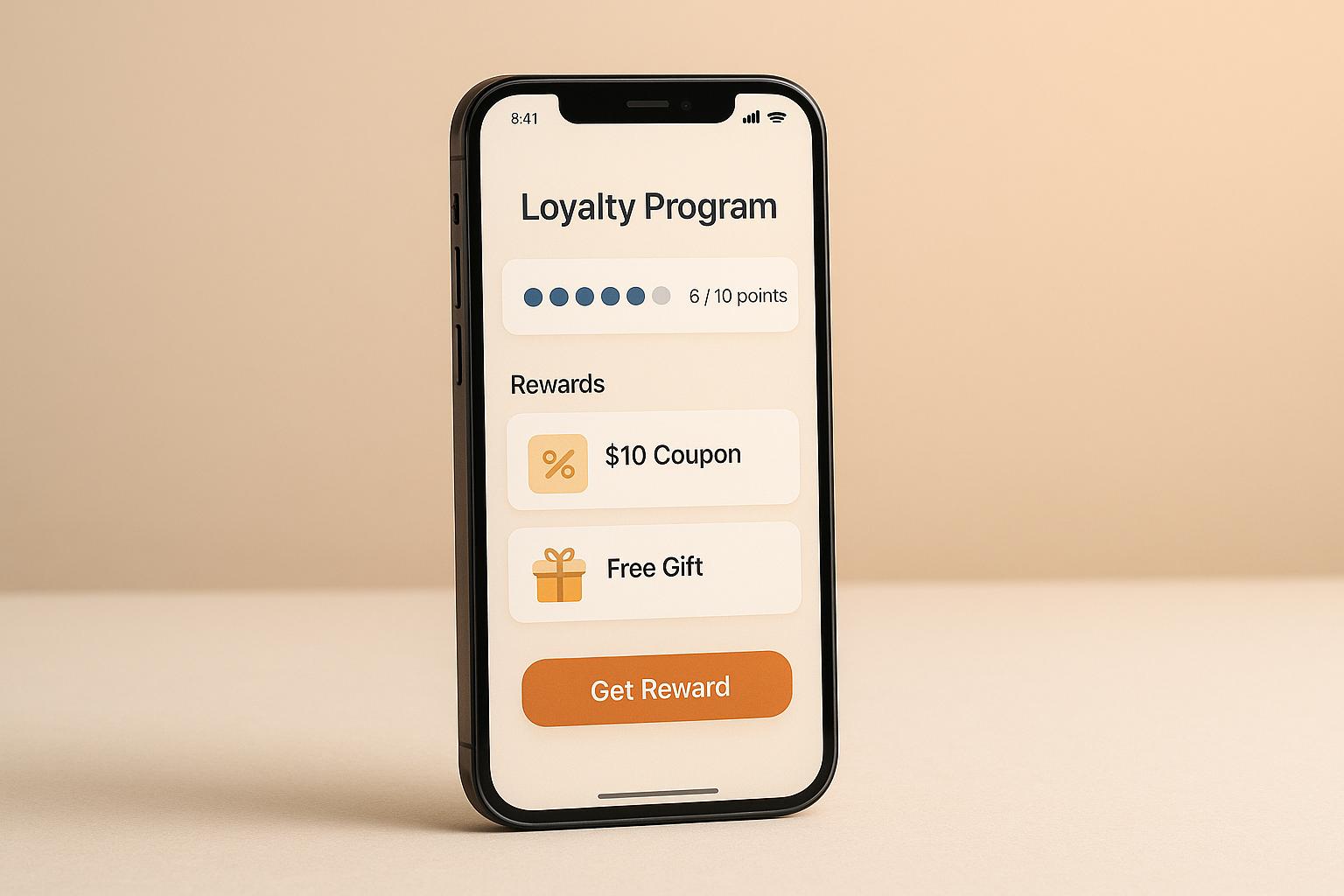
Want to boost app engagement and keep users coming back? Well-designed loyalty programs for apps can help you achieve this by rewarding repeat behavior, increasing purchase frequency, and improving customer lifetime value (CLV). Here’s a quick breakdown of how to create one:
- Set clear goals: Decide what you want to achieve, like higher retention, increased order value, or more frequent purchases.
- Choose a program type: Options include points-based systems, tiered memberships, or subscription models. Pick one that fits your business and audience.
- Create simple rules: Make earning and redeeming rewards straightforward. For example, “Earn 1 point per $1 spent; redeem 100 points for $5 off.”
- Design rewards that matter: Offer perks like discounts, free items, or exclusive access. Use tiers to motivate long-term engagement.
- Use no-code tools like AppInstitute: Platforms like this simplify setup, letting you build loyalty features without coding.
- Track key metrics: Monitor KPIs like retention, redemption rates, and incremental revenue to measure success and make improvements.
Loyalty programs can drive results if they’re easy to use and offer real value. Start with clear goals, simple rules, and engaging rewards to keep your users coming back.
Crash Course: How to Build a Loyalty Program

Set Goals and Choose Metrics for Your Loyalty Program
To create a loyalty program that truly works, you need clear goals and measurable metrics. Without these, it’s impossible to know if your program is effective or how to make it better.
Define Business and Customer Goals
A successful loyalty program balances your business objectives with what your customers value. When these align, you can boost revenue while offering real benefits to your users. Start by identifying two or three main business goals that are directly tied to your bottom line. Some common goals include increasing how often customers shop, raising the average order value (AOV), improving retention, or growing customer lifetime value (CLV). Keep these goals specific and measurable – vague aspirations like “get more customers” won’t cut it.
For example:
- A coffee shop might aim to increase monthly visits from 2.0 to 3.0 and AOV from $8.50 to $10.00 within six months.
- A local salon could target raising 90-day retention from 40% to 55% and increasing average annual spending from $300 to $380.
- A fast-casual restaurant might focus on boosting monthly visits from 1.5 to 2.2 and AOV from $14.00 to $16.50.
- A clothing retailer could aim to lift 60-day repeat purchase rates from 25% to 40% and grow AOV from $60 to $75.
Each goal should tie directly to a reward or earning mechanism. For instance, if you want customers to visit more often, you could offer bonus points for the fourth visit in a month. If you’re looking to increase order size, consider offering double points on purchases over $30.
Equally important are goals that benefit your customers. People join loyalty programs to save money, feel valued, and simplify their shopping. For example, you might promise regular diners they’ll save at least $20 a month in rewards after four visits. Or, ensure that users can earn their first reward – like a $5 appetizer – within 30 days of active participation. If customers typically earn 50–100 points per visit, a 500-point reward should feel achievable in the first month. Communicating these benefits clearly in your app helps set realistic expectations and builds trust.
Once your goals are set, it’s time to choose metrics to measure your program’s success.
Identify Key Performance Indicators (KPIs)
Before launching your loyalty program, gather three to six months of baseline data for key metrics. These might include purchase frequency, AOV, retention rates (e.g., the percentage of customers returning within 30, 60, or 90 days), revenue per customer segment, and discount usage. For example, a retailer in the U.S. might find their baseline metrics show 1.8 visits per customer per month, an AOV of $42.75, and a 90-day retention rate of 30%. These numbers will serve as benchmarks to measure improvements.
Here are some loyalty-specific KPIs to track:
- Enrollment rate: Calculate as (Number of loyalty members ÷ Total active app users) × 100. A low enrollment rate might mean your sign-up process is too complicated or the benefits aren’t clear.
- Active member rate: The percentage of enrolled members who make at least one transaction in a given period (e.g., 30 or 90 days). This helps you identify engaged members versus inactive ones.
- Retention rate: For a 90-day period, calculate as (Customers active at the end of the period who were also active at the start ÷ Customers active at the start) × 100. Comparing retention rates between loyalty members and non-members will show how well your program retains customers.
- Redemption rate: (Number of redeemed rewards ÷ Number of issued rewards) × 100. A low redemption rate (below 20%) might indicate that rewards are too hard to earn, poorly explained, or not appealing.
- Incremental revenue: The additional revenue generated by loyalty members compared to similar non-members or pre-program performance.
- Customer lifetime value (CLV): A long-term metric calculated as Average Order Value × Purchase Frequency × Average Customer Lifespan. Comparing CLV for loyalty members versus non-members helps assess the program’s impact over time.
For mobile apps, also track app-specific metrics like the percentage of app installs that convert to loyalty sign-ups, daily and monthly active users (DAU/MAU) among members, average sessions per week, session duration, and engagement with loyalty-related push notifications.
Interpreting these KPIs together is crucial. For instance, if both retention and redemption rates are low (with redemption under 20%), rewards might be too difficult to achieve or poorly communicated. A quick-service restaurant in the U.S. seeing a 15% redemption rate on “free drink” rewards might lower the points requirement from 1,000 to 600 points or add smaller rewards, like a free cookie after the second visit.
On the flip side, if retention is high but redemption rates are too high, cutting into profit margins, your rewards may be too generous. In this case, adjust the point conversion (e.g., from 100 points per dollar to 150 points per dollar) or restrict discounts to specific categories or times.
Segmenting your audience can also provide valuable insights. Analyze KPIs by group – such as new versus long-term members, high versus low spenders, or in-store versus in-app transaction users. For example, aim for new members to make two purchases and earn 1,000 points in their first 30 days, while requiring VIP members to spend over $200 monthly and visit three or more times.
If you’re using a no-code tool like AppInstitute, tie each goal and KPI to an in-app event, such as sign-ups, purchases, points earned, or rewards redeemed. AppInstitute’s analytics and user management features let you monitor these metrics without custom development. Set checkpoints at 30, 60, and 90 days after launch to review your KPIs and make adjustments to earning rules, redemption thresholds, or reward offerings as needed.
Lastly, avoid focusing on vanity metrics. A large number of loyalty members with low activity might indicate that your program’s goals or rewards don’t resonate with your audience.
Design Your Loyalty Program Structure
Now that you’ve established clear goals and metrics, it’s time to build a loyalty program framework that truly connects with your customers. This involves selecting a model that complements your business, setting straightforward rules for earning and redeeming rewards, and designing incentives that keep customers coming back. Let’s break it down into three key areas: selecting a model, creating rules, and designing rewards.
Select a Loyalty Program Model
The model you choose forms the backbone of your loyalty program and directly impacts how customers interact with it. Here are some common approaches:
Points-based programs are simple and easy to grasp. Customers earn points for every dollar spent, which they can later redeem for rewards. This straightforward system ensures clarity, but it’s vital to communicate the value of points effectively. If the connection between points and real rewards isn’t clear, customers may lose interest.
Tiered programs introduce membership levels like Silver, Gold, and Platinum, each offering better perks as spending increases. For example, a clothing retailer might set tiers at $500, $1,500, and $3,000 annually, with benefits ranging from birthday bonuses to exclusive customer service. This model encourages long-term engagement by motivating customers to achieve higher tiers, though it requires careful management and clear communication to succeed.
Subscription-based programs charge a membership fee in exchange for perks like free shipping, exclusive discounts, or premium content. This model ensures steady revenue but works only if the benefits justify the cost. Think of services like Amazon Prime, where the value is immediately apparent.
Hybrid models combine elements like points, tiers, and even gamification to appeal to a broader audience. For example, Walgreens incorporates points-based rewards, personalized offers, and health-related benefits into their program. This approach can engage different customer types, from those who love collecting points to those seeking instant perks.
Here’s a quick comparison of these models:
| Program Model | Advantage | Best Use Case | Limitation |
|---|---|---|---|
| Points-Based | Simple and easy to track | Frequent, small transactions | Points may feel meaningless without clear value |
| Tiered | Builds loyalty through aspiration | Encourages long-term engagement | Requires complex management |
| Subscription | Predictable revenue | High-value customers | Needs strong benefits to justify the fee |
| Hybrid | Appeals to diverse customer segments | Brands seeking maximum engagement | Can be challenging to set up and manage |
Create Earning and Redemption Rules
Clear rules are the foundation of any successful loyalty program. Start with simple, easy-to-understand earning structures. For instance, “Earn 1 point per $1 spent” is straightforward and avoids confusion. If your rules need a detailed FAQ to explain them, it’s likely time to simplify.
To keep customers engaged, show points immediately after each transaction – this instant feedback creates a sense of accomplishment. You can also offer time-limited bonuses, such as “Double points on all purchases this weekend”, to encourage more spending during specific periods.
When it comes to redeeming rewards, variety is key. Customers appreciate options beyond basic discounts. Consider offering:
- Discounts on future purchases
- Gift cards or cashback
- Exclusive product access or early sale invites
- Charitable donation options
Research shows that 75% of consumers are more likely to engage with programs offering mobile-friendly rewards like digital vouchers or codes. Ensure the redemption process is seamless – customers should be able to redeem rewards with just a few taps. Display point balances, eligibility, and redemption history clearly at checkout to build trust. Also, be upfront about point expiration dates to avoid frustration.
Design Rewards and Tiers
Once the rules are in place, focus on creating rewards that resonate with your audience. Think about what your customers already love and what might motivate them to spend more. For example, a coffee shop could offer free drinks or exclusive merchandise, while a clothing retailer might provide free shipping or early sale access.
Offer a mix of rewards to cater to different customer levels:
- Quick wins: Small rewards for new members to encourage participation.
- Regular rewards: Medium-sized perks to keep frequent customers engaged.
- Milestone rewards: Larger incentives for high spenders to work toward.
If you’re implementing a tiered program, aim for 3–5 levels with increasing benefits. For example:
- Silver: $500 annual spend – earn 1 point per $1 and a 100-point birthday bonus.
- Gold: $1,500 annual spend – earn 1.5 points per $1, a 250-point birthday bonus, and early sale access.
- Platinum: $3,000 annual spend – earn 2 points per $1, a 500-point birthday bonus, and perks like exclusive customer service.
Use visual tools like progress bars to show how close customers are to the next tier. Celebrating milestones, such as sending congratulatory messages when a customer levels up, can further strengthen loyalty.
Adding gamification can make the experience more engaging. For instance, challenges like “Earn 500 points this month for a bonus reward” give customers short-term goals. Features like spin-the-wheel offers or achievement badges add an element of fun and encourage frequent interaction with your app.
If you’re using AppInstitute to build your program, you’ll find tools like a drag-and-drop editor and user management features that make it easy to set up earning rules, tiered rewards, and redemption options. The platform also supports push notifications, so you can instantly inform customers about tier upgrades, bonus opportunities, or available rewards.
Finally, personalize the experience without overcomplicating it. Collect basic data like purchase history and preferences during onboarding to tailor rewards. For example, if a customer frequently orders breakfast, offering a coffee voucher can make the program feel more relevant and impactful.
sbb-itb-539ae66
Optimize the In-App Experience for Users
A loyalty program is only as good as the experience it provides, and a smooth in-app design can make all the difference. Even the most well-thought-out program can falter if users find the app confusing or hard to navigate. The goal is to create an interface that feels natural from the moment users open it, offering simple and clear ways to earn and redeem rewards. Once your program structure is in place, the next step is to focus on the in-app experience, ensuring users understand and enjoy engaging with your loyalty features. Here’s how to simplify onboarding, build an effective dashboard, and use gamification to keep users coming back.
Streamline Onboarding and Enrollment
First impressions matter. A complicated sign-up process can turn users away, so keep enrollment quick and easy. Integrate sign-up with actions users are already taking, like creating an account or checking out. For example, offer one-tap opt-ins that pull information from their existing account – name, email, and phone number should already be pre-filled. Better yet, consider auto-enrollment: when a logged-in user makes their first purchase, automatically enroll them in the program and notify them with a message like, “You’re now earning points on every purchase!” This approach removes friction while still allowing users to opt out if they choose. Just be sure the process is clear and respects privacy.
During onboarding, explain the program in a few simple steps. For example: “Earn 1 point for every $1 spent. Redeem 500 points for $5 off. Make your first purchase today to earn 100 bonus points.” Use plain language and stick to terms like “Rewards”, “Points”, and “Cash back”, which are familiar to most users.
Follow up with a welcome message, either through email or a push notification, that highlights the key benefits and includes a starter reward. This immediate value encourages users to make their first purchase and reinforces the decision to join. If you’re using AppInstitute, you can configure the loyalty and registration features to work seamlessly together, enabling one-tap enrollment without custom coding.
Clear communication about program rules during onboarding can prevent confusion later. Users should understand earning rates (“Earn 1 point per $1 spent before tax”), redemption thresholds (“Redeem in 100-point increments”), and expiration dates. Use clear U.S. date formats like “Expires on 06/30/2026” to avoid ambiguity. If your program includes tiers, explain how users can advance and when benefits reset, such as “Gold: Spend $500 in a calendar year to unlock.” Include a “How it works” or FAQ section that’s easy to find from both the onboarding process and the main dashboard.
Once users are enrolled, they’ll need an intuitive dashboard to track their progress.
Design a Loyalty Dashboard
The loyalty dashboard should serve as a one-stop shop for everything users need to know. Start by prominently displaying their current point balance – for example, “2,450 points” – using U.S. number formatting with commas for clarity.
If your program has tiers, include tier status and progress. Show the current tier name (like “Silver”) alongside a progress bar and numeric breakdown, such as “$120 of $300 spent to reach Gold.” Use clear dollar formatting ($120.00) to avoid confusion.
List available rewards with their monetary equivalents. Instead of just showing “500 points”, clarify the value: “$5 Off Coupon – 500 points.” Highlight expiration dates in U.S. format (MM/DD/YYYY), such as “Expires on 09/15/2026”, and use color-coded tags to draw attention to rewards nearing expiration.
The dashboard should also include a recent activity history that logs transactions, points earned, and redemptions. Each entry should have a date (e.g., 09/01/2026), a brief description (“Purchase at NYC Store”), the dollar amount ($45.20), and the points earned (+45 points). This transparency builds trust and reduces customer service inquiries.
Finally, include clear call-to-action buttons like “Redeem now”, “View rewards catalog”, or “Earn more points.” Make these buttons easy to find – ideally, they should be visible without scrolling. For mobile-first designs, stack elements vertically and group related information into collapsible sections (points, tiers, rewards) to maintain a clean, organized interface.
Real-time updates are crucial. Platforms like AppInstitute ensure the dashboard reflects the latest data across iOS, Android, and Progressive Web Apps, so users always see accurate information. This helps you track key metrics like active member rates and redemption rates.
Add Gamification and Notifications
Gamification can make routine actions more engaging, encouraging users to return to your app without feeling forced. The key is to align gamified elements with your business goals, such as increasing purchase frequency or average order size.
Challenges are a great starting point. Offer time-limited tasks like “Make 3 purchases this week to earn 300 bonus points” or “Try curbside pickup once for 100 bonus points.” These short-term goals feel achievable and drive specific behaviors.
Streaks are another effective tool. Reward users for consecutive actions, such as “Order coffee 5 days in a row for a $3 reward.” This approach works well for recurring habits, like daily coffee runs or weekly grocery shopping, and creates a sense of momentum – users won’t want to break their streak.
Badges and milestones add a layer of visual recognition. Award badges for achievements like “First Purchase”, “Weekend Shopper”, or “Big Spender ($200+ in a month).” Pair these badges with small perks like bonus points or early access to sales. These rewards give users something to work toward beyond just accumulating points.
Interactive features like daily surprises or spin-the-wheel bonuses can also boost engagement. For example, some apps let users “shake their phone to reveal today’s offer.” Just be transparent about any random elements – clearly state the odds or reward ranges to avoid frustration.
Push notifications and in-app messages are essential for keeping users engaged, but they need to be timely and relevant. Research shows that 75% of consumers are more likely to engage with loyalty programs offering mobile-friendly rewards. Use behavioral triggers to send personalized notifications, such as reminders about expiring rewards or updates on tier progress. For example, if a user frequently orders breakfast, send them a coffee voucher instead of a generic discount.
To avoid overwhelming users, limit the frequency of notifications and allow them to customize their preferences. Coordinate push alerts with email or SMS for major updates, like tier changes or significant rewards, while respecting privacy norms and opt-in requirements.
With platforms like AppInstitute, you can automate notifications based on user actions, creating a seamless experience that keeps users informed and engaged.
Implement, Launch, and Optimize Your Program
Turn your plans into action by setting up, testing, and refining your loyalty program using AppInstitute. Here’s how to configure your program, run effective tests, and make data-driven improvements over time.
Set Up the Program Using AppInstitute
AppInstitute’s no-code platform simplifies the process of creating a loyalty program – no coding skills required. You can typically complete the setup in just a few hours, depending on how detailed your rules and rewards are.
- Step 1: Log in and select a template. Start by logging into your AppInstitute dashboard. Choose an industry-specific template – like restaurant, salon, or retail – that suits your business. These templates come with pre-designed layouts you can easily customize.
- Step 2: Add the loyalty module. From the feature library, drag the loyalty module into your app’s navigation. Make it a prominent tab where users can track their points, stamps, or rewards.
- Step 3: Define program details. Give your program a name and a brief description, such as: “Earn 1 point per $1 spent. Redeem 500 points for $5 off.” Be sure to include terms like point expiration dates, transfer restrictions, and exclusions.
- Step 4: Set earning rules. Assign points or stamps for specific actions, such as spending money, completing a profile, placing a first mobile order, or referring a friend. Keep the rules simple and easy to understand.
- Step 5: Create a rewards catalog. Offer rewards like discounts, free items, birthday gifts, or even charitable donation options. Use clear, round numbers (e.g., 100 points = $10 off) to avoid confusion.
- Step 6: Configure dashboard settings. Ensure the loyalty module displays key information, such as current points, progress toward rewards, recent activity, and expiration dates. For example: “2,450 points ($24.50 value) • Expires 06/30/2026.”
- Step 7: Automate notifications. Set up push notifications for key events like enrollment confirmation, point accumulation, reward unlocks, and upcoming expirations. AppInstitute makes automating these messages easy.
- Step 8: Sync external systems. If needed, connect your loyalty program to external tools like a POS system or CRM. This ensures points earned in-store or online update in real time.
- Step 9: Test and publish your app. Preview your app using the emulator to check layout and flow. Once satisfied, generate test builds for iOS and Android, then publish the app to the Apple App Store and Google Play.
With the setup complete, you’re ready to move into testing.
Test and Pilot Your Program
Before a full launch, run a pilot program to test functionality and gather feedback. This step helps you refine rules, fix technical issues, and ensure the program drives the desired customer behaviors.
- Start small. Invite a limited group of 50 to 500 users – such as loyal customers or staff – for the pilot. Use AppInstitute’s segmentation tools to tag participants and send them targeted messages.
- Set a timeline. Run the pilot for 4–8 weeks. This timeframe covers one or two buying cycles, giving you enough data to identify trends. Compare baseline metrics (like visit frequency or order value) to performance during and after the pilot. For deeper insights, track a control group that isn’t part of the program.
- Collect feedback. Use in-app forms or follow-up emails to ask participants about their experience. Focus on areas like ease of enrollment, clarity of earning rules, and the appeal of rewards.
- Monitor stability and engagement. Keep an eye on technical performance – watch for crashes, slow loading times, or data sync issues. At the same time, track metrics like enrollment rates, how quickly users earn points, and the average time to first redemption.
- Experiment with A/B tests. Test different program elements to see what works best. For example:
- Variant A: 1 point per $1 spent, with a $5 reward at 50 points.
- Variant B: 2 points per $1 spent, with a $5 reward at 100 points.
Compare enrollment rates, earning activity, and redemption times. You can also test reward options (e.g., discounts vs. free items) and notification strategies (essential updates vs. additional nudges). Use AppInstitute’s tools to analyze outcomes and fine-tune your program.
Monitor Performance and Make Improvements
Launching your loyalty program is just the beginning. To keep it effective, regularly track key metrics and make adjustments as needed.
- Enrollment Rate: This measures how many active users sign up for the program. A healthy rate typically ranges from 30% to 70%. If your rate is below 30%, consider simplifying the sign-up process or offering a stronger welcome bonus.
- Active Participation Rate: This tracks how many enrolled members earn or redeem points within a 30-day period. If participation falls below 40%, it may indicate that the program isn’t engaging enough.
- Redemption Rate: This shows the percentage of rewards redeemed compared to rewards issued or points earned. Low redemption rates (under 30%) could mean rewards are unappealing, too hard to achieve, or not clearly communicated.
Conclusion
Creating a loyalty program that truly works requires setting clear objectives, designing an easy-to-understand reward system, ensuring a smooth in-app experience, and consistently monitoring its performance.
Start by identifying your primary goals – whether it’s increasing how often customers visit, boosting the average order value, or improving retention rates. Use measurable indicators like repeat purchase rates, active participation levels, and redemption rates to track your progress. Once you’ve defined your goals, choose a program model that aligns with your business needs. For instance, points-based systems are simple and effective, while tiered programs can encourage customers to spend 30–40% more than non-members.
The design of your loyalty program should integrate seamlessly with your mobile app. Make it easy for users to sign up and navigate by including features like a loyalty dashboard that clearly shows points balances, progress toward rewards, and expiration dates. Push notifications can also be an effective tool to keep users engaged. For example, you can notify them when they’re close to earning a reward or when points are about to expire – just be sure to use these alerts sparingly and strategically to avoid overwhelming your customers.
No-code platforms like AppInstitute can simplify the process of building and managing these features. With tools like a drag-and-drop editor and pre-built loyalty components, AppInstitute allows small and midsize businesses to quickly set up and tweak their programs. Whether you want to roll out double-points promotions for Black Friday, experiment with new rewards, or refine your messaging, these platforms make it easy to adapt without relying on developers. This kind of flexibility is especially useful for businesses in the U.S. that need to adjust quickly to seasonal trends or customer feedback.
Before fully launching your program, consider running a pilot to test its functionality and gather initial feedback. A/B testing different reward structures, monitoring key metrics, and collecting customer input through in-app surveys can provide valuable insights to refine the program over time.
It’s worth noting that 84% of consumers are more likely to stick with a brand that offers a loyalty program. By focusing on simplicity, relevance, and continuous improvement, you can turn your app into a powerful tool for driving repeat purchases and building strong, long-term customer relationships. Keep it straightforward, data-driven, and customer-focused to ensure lasting success.
FAQs
What’s the difference between points-based, tiered, and subscription loyalty programs, and how do I choose the right one for my app?
Points-based programs are a simple and effective way to reward users for specific actions, such as making purchases or engaging with your app. Users earn points that can later be redeemed for discounts or perks. The straightforward nature of this approach makes it easy for users to grasp and encourages frequent interactions.
Tiered programs, on the other hand, offer rewards that increase in value as users reach higher activity levels. This structure not only keeps users engaged but also motivates them to aim for the next tier to unlock better benefits over time.
Subscription-based loyalty programs take a different approach by offering exclusive perks – like free shipping or special discounts – in exchange for a recurring fee. These are particularly effective for apps with a dedicated user base willing to pay for premium experiences.
When deciding which program fits best, think about your app’s goals, how your users behave, and what types of rewards will resonate most with your audience. Testing different strategies and gathering user feedback can help fine-tune your program to deliver the best results.
What are the best KPIs to measure the success of my app’s loyalty program?
To gauge how well your app’s loyalty program is performing, it’s essential to keep an eye on key performance indicators (KPIs) that highlight user engagement and the program’s overall impact. Here are a few critical metrics to consider:
- Customer retention rate: This shows how effectively your program encourages users to stick around and remain loyal.
- Repeat purchase rate: Measures how often customers come back to make additional purchases.
- Engagement metrics: Includes data like app sessions, interactions with push notifications, and other signs of user activity within the app.
- Reward redemption rate: Tracks how often users claim and use their rewards.
By consistently analyzing these KPIs, you can pinpoint strengths, make improvements where needed, and build stronger connections with your customers over time.
How can I use gamification in a loyalty program to boost user engagement?
Gamification can breathe new life into your app’s loyalty program by adding fun, interactive elements that keep users coming back for more. Here’s how you can make it happen:
- Celebrate milestones: Reward users with points, badges, or special perks when they hit key achievements, like reaching a specific number of purchases or referring friends.
- Add challenges: Spice things up with limited-time tasks or events, such as earning double points during a weekend promotion, to keep users engaged and motivated.
- Use leaderboards: Highlight user rankings to spark friendly competition and encourage continuous participation.
With these game-like features, you can design a loyalty program that feels fresh, exciting, and keeps your users hooked.
Related Blog Posts
Last Updated on December 10, 2025 by Becky Halls
0 thoughts on “How to Design Loyalty Programs for Apps”