Let’s be honest. Somewhere on your high street there’s a big green mermaid staring at your café, arms folded, whispering “cute little shop you’ve got there.” The chains have the budgets, the drive-thrus, and an app that half the country seems to have surgically attached to their thumb.
Here’s the plot twist nobody tells you: that app is exactly where you can catch them up. The big chains aren’t winning because their flat white is better than yours (we both know it isn’t). They’re winning because they turned loyalty into a little glowing rectangle in everyone’s pocket. And in 2026, thanks to no-code app builders, that same weapon costs you roughly the price of a few bags of beans a month.
So grab your third coffee of the morning and let’s talk about how the little guy out-brews the giant.
Why do the big coffee chains win so often?
It’s not the coffee. It’s the habit loop. Starbucks Rewards members now drive around 60% of the company’s US sales, and those members spend roughly 2.5 to 3 times more than people who just wander in off the street. Mobile order-and-pay alone accounts for about a third of their transactions.
Read that again. The majority of a coffee empire’s revenue comes from people who signed up, downloaded the app, and got gently nudged back through the door every week. It has almost nothing to do with the drink and everything to do with owning the relationship.
The chains figured out years ago that the phone is the new punch card, the new voucher, and the new “morning, love, the usual?” all rolled into one. The good news? None of that is patented. You can do the exact same thing, only warmer, funnier, and without a corporate committee approving your emoji use.
“People think they’re competing with the chains on coffee. They’re not. They’re competing on convenience and memory. An app hands an independent shop both, and suddenly being the small local place stops being a disadvantage and becomes the whole point.” Ian, AppBuild.diy
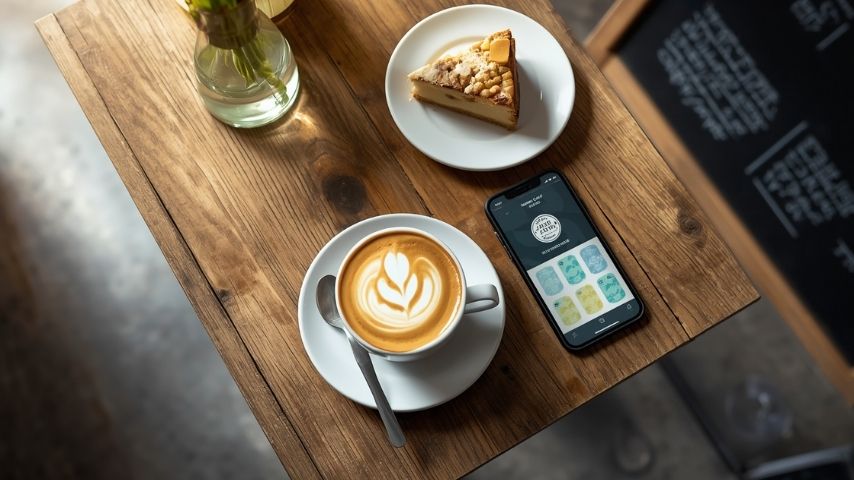
But aren’t apps just for the big brands?
This is the myth that keeps brilliant little cafés stuck with a chewed-up paper stamp card and a jar of biros by the till.
Ten years ago, yes, a custom app meant a five-figure quote and a developer who ghosted you halfway through. Today you can build one yourself by dragging blocks around a screen, no code, no computer science degree, no crying into your oat milk. If you can set up a table booking or post to Instagram, you can build a coffee shop app.
And here’s the bit that genuinely stings the chains: your customers actually like you. You know Dave has a decaf oat cortado. You know the school-run mums descend at 8:50am. Starbucks has data; you have relationships. Bolt an app onto that relationship and you get the best of both worlds.
“The independents that win aren’t trying to out-corporate the corporates. They’re taking the one thing a chain can never fake, that they genuinely know their regulars, and putting it in an app. That’s a superpower Costa would pay millions for.” Becky, AppBuild.diy
What should a coffee shop app actually do?
Resist the urge to cram in seventeen features. A great coffee shop app really only needs to nail a few things:
A digital loyalty card, so nobody ever again says “I think I had eight stamps but the dog ate the card.” Order-ahead, so the 8:50am crowd can skip the queue and you can turn over more cups in the rush. Push notifications, your secret afternoon-slump weapon (more on that in a second). And a simple menu with your specials, seasonal drinks, and the cake situation, which is frankly the most important information a human can receive.
That’s it. Start there. You can add subscriptions, referrals, and event bookings once the basics are humming.
Isn’t a paper stamp card basically the same thing?
Bless the paper stamp card. It has served us well. It is also, in 2026, about as effective as shouting your offers into a well.
Paper punch cards get lost, forgotten, and left in coat pockets, which is why their redemption rates limp along at under 10%. Move that same scheme to a digital card that lives in Apple Wallet or Google Wallet and redemption typically jumps to 30% or higher, with some shops reporting a 40% lift in retention within the first quarter of ditching paper. Given that loyal coffee customers spend around 67% more than newbies, that is not a rounding error. That is your rent.
The kicker: with app fatigue very real (roughly three quarters of people groan at downloading yet another app), the smart move is a loyalty card that drops straight into the digital wallet they already use. No clutter, no faff, just a card that can never be washed in the machine on a hot cycle.
How do I actually get people to download it?
The eternal question, and the honest answer is: bribe them, kindly. People download things when there’s an immediate payoff.
Put a QR code on every table, on the till, on the takeaway cups, and above the milk station where everyone stands looking slightly lost. Pair it with a hook that’s impossible to ignore: “Scan for a free coffee on your first order” or “Download the app, skip the queue, feel smug.” Train your team to mention it in the ten seconds while the machine does its thing, because a friendly human recommendation beats any poster.
The trick is making the app the only place certain good things live. App-only Friday pastry deals. App-only early access to the new seasonal menu. App-only “it’s raining, here’s 20% off a hot one” flash offers. Give people a reason to keep it, not just get it.
Can push notifications really bring people back?
This is the feature that makes owners go a bit misty-eyed once they see it work.
Every café has a dead patch. The 2:30pm lull where the lunch rush has gone and nobody’s arrived for their afternoon fix yet. A well-timed push notification (“Quiet-afternoon treat: buy one, get one on all lattes til 4pm”) can turn that ghost-town hour into actual takings. It’s like having a megaphone that only speaks to people who already love you, which, unlike Facebook’s dwindling organic reach, actually reaches them.
The golden rule: don’t be annoying. One or two genuinely useful nudges a week, not a barrage. Think of push notifications like sprinkles on a flat white. A little is delightful. A lot is a menace.
“Push notifications are the closest thing a small business has to a superpower, and the fastest way to waste it is to spam. Send one message people are glad to get, at the exact moment it’s useful, and watch a slow Tuesday fill up. Restraint is the whole game.” David, AppBuild.diy
What about coffee subscriptions and the fancy stuff?
Once your loyalty and order-ahead are ticking along, subscriptions are the natural next brew. A “daily drink club” where regulars pay a monthly fee for a coffee a day turns unpredictable footfall into lovely, predictable recurring revenue, and subscription schemes have been shown to lift monthly retention by around 40%.
But you don’t need to start there. Walk before you sprint. Get the basics loved first, then layer on the clever stuff. A café that nails a simple digital loyalty card will outperform one juggling ten half-baked features every single time.
The takeaway
You are never going to out-budget Starbucks, and you shouldn’t try. But you can absolutely out-personalise them. The chains built billion-pound habits out of an app and a loyalty scheme. In 2026, those same tools sit in your apron pocket for a few quid a month, and you’ve got the one thing they can’t buy: you actually know your regulars’ names.
So let the mermaid keep folding her arms. You’ve got better coffee, better banter, and now an app that remembers Dave’s decaf oat cortado. Game on.
FAQ
Do I need to be techy to build a coffee shop app? Nope. No-code builders like AppBuild.diy let you drag and drop features together, no coding required. If you can manage a social media page, you can manage this.
How much does a coffee shop app cost? A fraction of what it did a decade ago. No-code platforms run on affordable monthly subscriptions, usually less than you’d spend on a couple of bags of premium beans, with no big upfront developer bill.
Will customers really download an app for one coffee shop? They will if there’s a clear payoff. A free first coffee, queue-skipping, and app-only deals turn a download into a no-brainer. Keep the reward instant and obvious.
What’s the single most important feature to start with? A digital loyalty card. It’s the easiest win, it replaces the flimsy paper card, and it gives customers a reason to come back and to open the app in the first place.
How often should I send push notifications? Once or twice a week, maximum, and only when you’ve got something genuinely useful to say. Useful and rare beats frequent and ignored every time.
Can an app help during quiet hours? Absolutely. A timely push offer during your afternoon lull is one of the quickest ways to turn dead time into real sales.
Last Updated on July 30, 2026 by Becky Halls
0 thoughts on “Can My Coffee Shop Beat Starbucks? Let’s See…”