Most people imagine “starting an app business” looks like this: eighteen months in a hoodie, a whiteboard covered in things nobody understands, and a developer named Kai who quits halfway through to go travelling.
It does not have to look like that. With a white-label reseller platform, launching an app business looks a lot more like setting up a new service on your existing website, except the service happens to be worth thousands of pounds a client and renews every single month.
So let’s do the honest thing nobody else does and map out the actual fortnight. Not the fantasy, not the “results not typical” small print. Just what days one through fourteen realistically look like when you sign up to the AppBuild.diy reseller partner programme and decide to take it seriously.
Grab a coffee. This is the calmest two weeks of business-building you’ll ever read about.
What actually happens on day one?
Day one is the day that feels suspiciously easy, and that’s the point.
You start your 7-day free trial, point your domain (something like apps.youragency.com), and the platform’s SSL goes live behind it. That’s the technical heavy lifting done, and notice that you did not touch a line of code, did not open a terminal, and did not have to know what “SSL” stands for to have it working.
By the end of day one you’ve got a platform that is genuinely yours. Your logo, your colours, your login screen. When a client logs in, they see your brand, not ours. That’s what “white label” actually means, and it’s the difference between reselling apps and looking like you’re reselling someone else’s apps.
“The first-day panic people expect never arrives,” says Ian from AppBuild.diy. “They brace themselves for a big scary setup and then it’s basically ‘upload your logo, pick your colours, done.’ The hardest decision on day one is usually which shade of blue.”
The plumbing underneath (hosting and security via Cloudflare, publishing to the Apple App Store and Google Play, payments through Stripe, Apple Pay and Google Pay) is already built, tested and running. You are renting the factory, not building it.
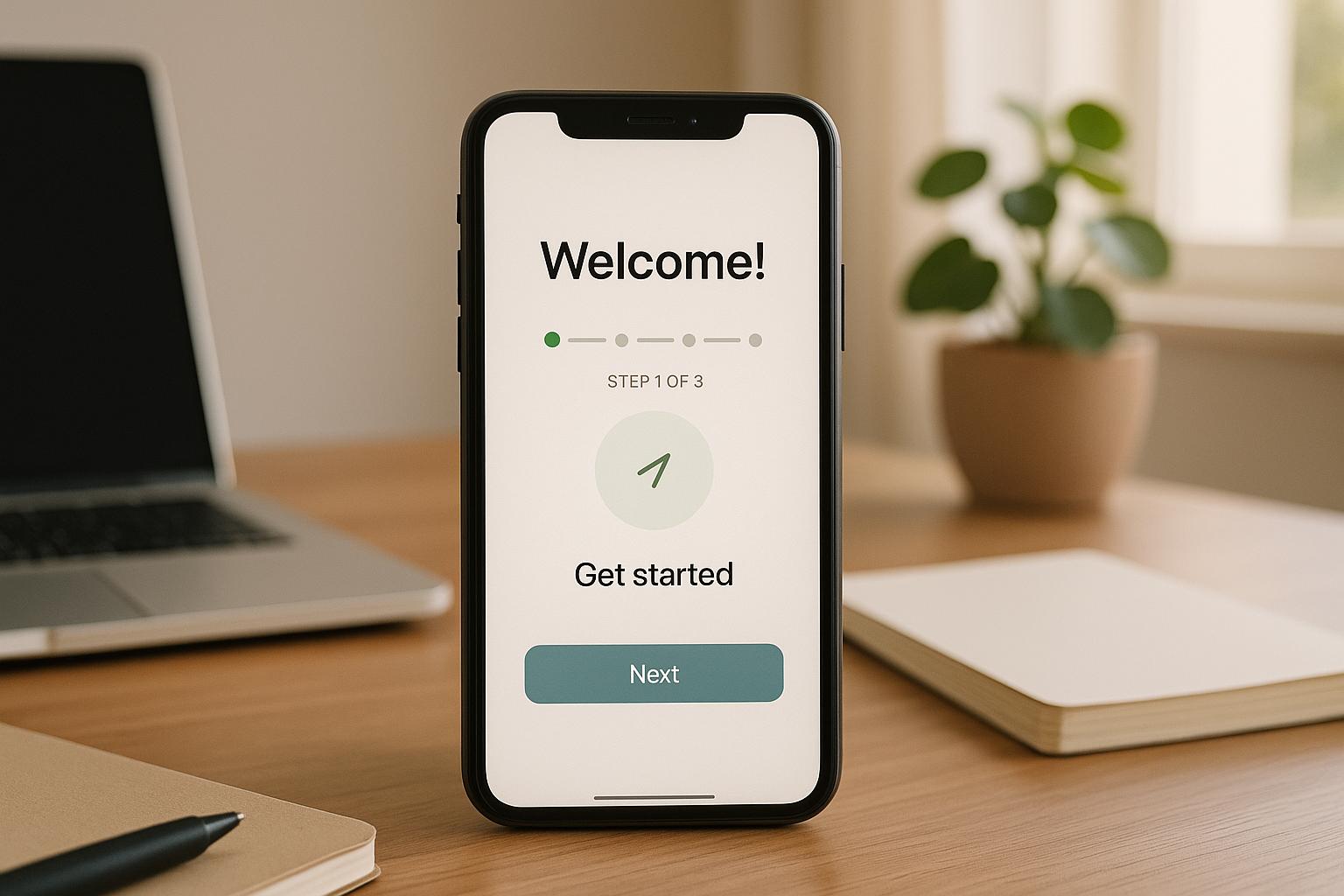
10 Mobile App Onboarding Tips for Small Businesses
When do I get to build my first actual app?
Days two and three. And this is where the disbelief usually kicks in.
You build your first app to learn the ropes, ideally a demo for a made-up business in a niche you want to sell into. A cafe, a gym, a salon, a tattoo studio, whatever your local patch is heavy on. Drag, drop, add a loyalty card, add push notifications, add order-ahead. Publish. Scan the QR code. There it is on your phone, running, real.
The reason you can do this in an afternoon rather than a quarter is the whole no-code shift the industry has been quietly going through. Traditional development drags on for months, whereas the average no-code or low-code project now ships in around 3.2 weeks versus 14.8 weeks for the same thing built the old way, according to ToolJet’s 2026 low-code statistics. And a reseller app on a mature platform is faster still, because most of the app is already built. You’re assembling, not inventing.
“I tell new resellers to build the ugliest, most over-the-top demo they can on day two,” says Becky from AppBuild.diy. “Cram every feature in. Not because a client needs all of it, but because ten minutes of clicking around teaches you more than ten hours of watching tutorials. You learn the tool by playing with it.”
Build a couple of these. Break things. Nobody’s watching. By day three you can build a clean, sensible app for a real business without thinking too hard about it.
When does a real client see something?
Around day seven, and this is the move that separates people who launch from people who “are looking into it.”
You take one of your demo apps, rebrand it to a real local business you’d like to work with, and show them their own app. Not a slideshow. Not a maybe. Their name, their logo, their loyalty card, sitting on a phone in your hand.
Selling stops being abstract the second a business owner watches their own brand animate onto a screen. You are no longer asking them to imagine having an app. You’re asking them whether they want to keep the one you just showed them. Very different conversation, much shorter, far more likely to end in a yes.
Which businesses do you show first? The repeat-visit kind, the ones whose whole model depends on people coming back: cafes, gyms, salons, takeaways, retail, holiday lets. And warm ones before cold ones. The client you already build a website for, or the gym you actually go to, is a far kinder first pitch than a stranger.
When do I send my first invoice?
Day fourteen is the target for money out the door, and it’s very achievable if you did the demo on day seven and let it breathe for a week.
Here’s the maths that makes the whole thing work, because this is really a numbers game dressed up as a tech business. Your platform licence is a flat $599 a month, and that single licence covers up to 50 customer apps. You charge each client a setup fee plus a monthly retainer, typically somewhere around £49 to £99 a month per app.
Do the sum. At £99 a month you break even at roughly six or seven clients. Client eight onward is close to pure margin, because your cost stays flat while your revenue keeps climbing. Contrast that with a bespoke two-platform app build, which quotes anywhere from £15,000 to £40,000 for a single app for a single client, before maintenance, and you can see why the reseller partner model tends to make agency owners go quiet and reach for a calculator. There’s an ROI calculator on the page for exactly that moment, so you don’t have to do it on the back of an envelope.
“The mental shift that has to happen by week two is from project money to recurring money,” says David from AppBuild.diy. “One-off web builds pay you once and then you’re hunting the next one. App retainers pay you every month for years. Ten clients at £99 is nearly a thousand pounds landing in your account before you’ve done a thing that morning. That’s the bit that changes people’s businesses.”
So by the close of the fortnight the realistic picture is: branded platform live, a few demo apps built, at least one real client shown their own app, and a first invoice out. Not a finished empire. A working, revenue-generating start.
But what do I actually say to the client?
This is the real objection, and it’s fair. Most people who worry they “can’t do this” don’t mean they can’t build the app. They mean they don’t know what to put in the email, what to charge, or what to say when a client goes “hmm, how much?”
That’s exactly why the programme includes a reseller sales kit, and it’s the part that quietly does the most work. You get a rebrandable pitch deck, a pricing sheet, demo apps by industry, a four-email outreach sequence, and an objection-handling one-pager. So in your first fortnight you are not staring at a blank page inventing a sales process from scratch. You’re editing a proven one and putting your name on it.
The apps themselves earn their keep because that’s simply where people’s attention lives now. Users spend the overwhelming majority of their mobile time inside apps rather than the mobile web, and analysts expect around 70% of new business applications to be built on no-code or low-code platforms, per Kissflow’s 2026 no-code statistics. You’re not early to this. You’re right on time.
Is two weeks honestly realistic, or is this hype?
Honest answer: two weeks is realistic for the launch, not for the empire.
Fourteen days is enough to have a live white-label platform, real demo apps, a real client conversation and a first invoice. What it is not is enough to have a full book of clients, because that part depends on how many people you talk to, and no platform can do the talking for you. If you sign up, disappear, and open the dashboard again in November, your first fourteen days will simply be whichever fortnight you actually show up for.
The people who Google around first will bump into the usual names, Bizness Apps, Swiftic, GoodBarber white label, the lot. Compare properly. Look at the licence cost as an actual number, how many apps each licence covers, whether it truly runs on your own domain, and whether there’s a real trial. When you line those up, a flat $599 a month covering up to 50 apps, with a 7-day trial and a sales kit thrown in, tends to hold up well.
Two weeks in, you won’t be finished. You’ll be started. And started is the hard part everyone else keeps putting off until January.
How to Launch a White-Label App Reseller Business – FAQ
How much does it cost to become a white-label app reseller? The platform licence is a flat $599 a month, or a discounted upfront annual (see the page for current pricing), and there’s a 7-day free trial so you can build your first app before paying anything. One licence covers up to 50 customer apps, with more capacity available on request as you grow.
Do I need to know how to code to launch in 14 days? No. The platform is fully no-code, there’s no dev team required, and the technical parts (hosting and security via Cloudflare, App Store and Google Play publishing, and Stripe, Apple Pay and Google Pay payments) are already built and handled for you.
How much should I charge my own clients? Most resellers charge a setup fee plus a monthly retainer of around £49 to £99 per app. At £99 a month you break even at roughly six or seven clients, and everything after that is largely margin because your licence cost stays flat.
Will my clients know the apps aren’t built by me? No. The programme is fully white label. Your brand, your logo, your login screen and your own domain (like apps.youragency.com). Clients see you, not us.
What if I can build apps but can’t sell them? The reseller sales kit covers that: a rebrandable pitch deck, pricing sheet, demo apps by industry, a four-email outreach sequence, and an objection-handling one-pager. You start by editing a proven process rather than inventing one.
Where do I start? Start the 7-day trial on the reseller partner programme page, point your domain, build a demo, and play with the ROI calculator to see the numbers for your own client count. Also check out our LinkedIn page to connect with other resellers!
Last Updated on August 25, 2026 by Becky Halls
0 thoughts on “How to Launch a White-Label App Reseller Business in Your First 14 Days”