You had a spare evening, a strong coffee, and a slightly wild idea (we’ve all been there!). Three hours later, Lovable (or Base44, or Bolt, or whichever vibe-coding tool you fell down a rabbit hole with) had handed you a working app. It looks great. It does the thing. You showed your partner and they said “oh, that’s actually good,” which is the highest praise available in most households.
And then the question hits you: now what? It lives at some-random-name.lovable.app in a browser tab. It is not on your phone’s home screen. It is definitely not on the App Store. So how do you turn a vibe-coded app into a real mobile app that people can download, tap, and actually use? That is exactly what this post is about, so grab the rest of that coffee.
So you vibe-coded an app. Why isn’t it on the App Store yet?
Because what you built is a web app, and the App Store and Google Play want native mobile apps. Those are not the same thing, even though they can look identical on screen.
Vibe-coding has gone properly mainstream. Lovable alone has passed a $500 million annual revenue run rate with around 8 million users, and roughly 80% of its builders describe themselves as non-technical. Translation: millions of people are building genuinely useful apps without touching a line of code they understand. The building part has been solved. The “getting it onto a phone as a proper app” part has not, and that is where most people get stuck.
Your vibe-coded app runs in a web browser. To live on the App Store and Google Play, on someone’s home screen, with a push notification when something happens, it needs to be packaged (or “wrapped”) as a native iOS and Android app. That is a separate job, and it is the bit the AI tool tends to wave at vaguely and then change the subject.
“People come to us buzzing. They have built something real in an afternoon and they cannot believe it. Then they realise the last mile, actually shipping it as an app, is the bit nobody warned them about. That gap is exactly what we close,” says Ian at AppBuild.diy.
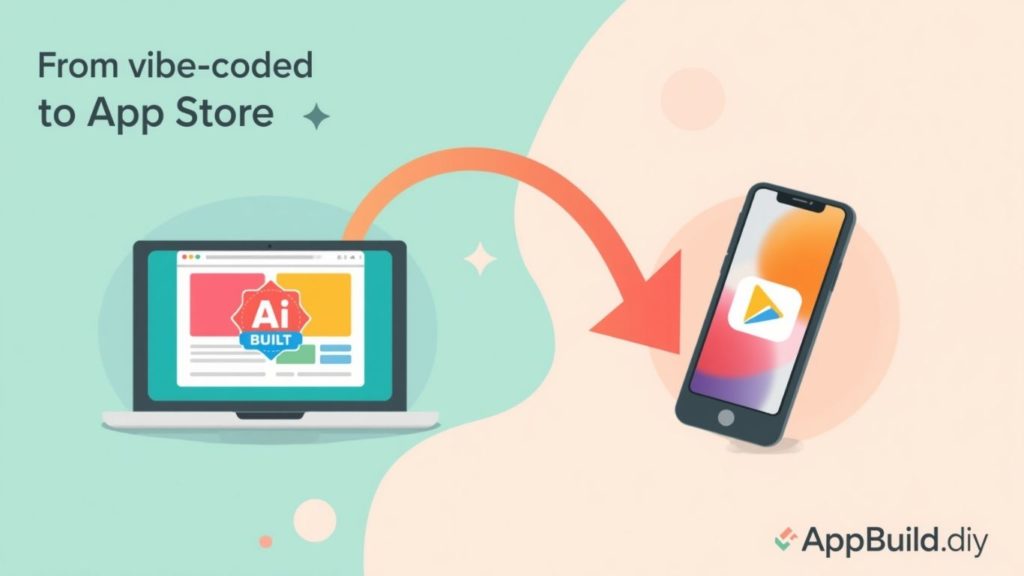
What does “wrapping” a vibe-coded app actually mean, and why does it beat a raw web build?
Wrapping means taking your working web app and packaging it into a proper native shell for iOS and Android, so it installs from the App Store and Google Play, sits on the home screen, and behaves like the apps you already use every day.
Why bother, when it already works in a browser? Because a home screen icon is worth a small fortune in attention. In 2026, people spend roughly 94% of their smartphone time inside native apps, and app users convert at about 3.5% versus 2% on mobile web, so nudging north of 3x. A link in a browser tab gets forgotten by Tuesday. An icon on the home screen gets tapped every day.
A properly wrapped app also unlocks the things a browser tab simply cannot do well: push notifications, a real presence in the App Store and Google Play (which is still where huge numbers of people go to find and trust an app), smoother performance, and that reassuring “this is a real business” credibility. Your idea deserves better than living as a bookmark.
Why do so many AI-built apps get rejected from the App Store?
Because a lazy wrap, a thin web page in a native jacket, trips Apple’s rules, and Apple has become notably fussier about exactly this.
This is the trending bit you need to know about. In early 2026, Apple started blocking vibe-coded apps from the App Store, leaning on Guideline 2.5.2 (apps must not download or run code that changes what they do) and Guideline 4.2 (minimum functionality, basically “this feels like an empty template, no thanks”). Several well-known AI builders got caught out. The pattern is consistent: a raw web app hurriedly wrapped for mobile is the fastest route to a working app, and also the fastest route to a rejection email.
So the goal is not to slap a webview around your project and cross your fingers. The goal is to wrap it properly, so it reads as a genuine, self-contained native app that clears review the first time. This is precisely why we fix the niggles before we wrap, rather than after.
“The rejection emails are brutal because they are vague. You get a guideline number and a shrug. Half our job is knowing what Apple actually means by ‘minimum functionality’ so your app sails through instead of bouncing three times,” says Becky at AppBuild.diy.
Do I need to fix my Lovable or Base44 app before wrapping it?
Almost always, yes, and this is the step people skip at their peril. Vibe-coded apps are brilliant at looking finished while hiding a few gremlins under the bonnet.
The usual suspects: a login that works 90% of the time, a form that forgets what you typed, buttons that do nothing on a real phone even though they were fine on your laptop, a layout that looks lovely on desktop and falls apart on a small screen, and the classic, an app that assumes a fast laptop connection and stalls on a train. None of these are disasters. All of them will annoy a real user and some of them will get you rejected.
Fixing the niggles first does two things. It gives your users an app that feels solid rather than slightly haunted, and it clears the “minimum functionality” and quality bars that reviewers care about. Wrapping a buggy app just gives you a buggy app on the App Store, which is worse, because now strangers can leave one-star reviews about it. So we tidy the gremlins, then we wrap.
Lovable to mobile, Base44 to mobile: what does the process actually look like?
At a high level it is refreshingly boring, which is what you want when your goal is “on the App Store by next week.” Here is the shape of it.
First, we look at your vibe-coded app and list what needs fixing before it goes anywhere near a store. Second, we sort those niggles, the login, the forms, the mobile layout, the offline behaviour, the performance stutters. Third, we wrap it into native iOS and Android builds so it installs like any other app, with push notifications and a proper home screen presence. Fourth, we handle the fiddly publishing bits: App Store and Google Play submission, the store listing, the screenshots, the review guidelines that trip everyone up. You keep your idea and your brand. We deal with the plumbing.
The lovely part is that you do not throw away the thing you already built. Your Lovable or Base44 app is the starting point, not scrap. You vibe-coded the hard, creative bit. Getting it wrapped, fixed, and published is the unglamorous bit we genuinely enjoy.
“The best feeling is when someone searches their own app’s name in the App Store, finds it, downloads it, and just goes quiet for a second. That was a browser tab last month. Now it is a real app with their name on it. That never gets old,” says David at AppBuild.diy.
Isn’t a PWA good enough?
Sometimes, for some things, sure. A Progressive Web App can be a perfectly reasonable stepping stone, and for a simple internal tool it might be all you ever need. But “good enough” and “what your idea deserves” are often different sentences.
A PWA still is not really in the App Store or Google Play in the way people expect. It leans on the browser, push notifications on iOS have historically been temperamental, and it lacks the trust signal of a proper store listing. If you are building something you want strangers to download, pay for, or rely on daily, a native wrap gives you the home screen icon, the store presence, the smoother feel, and the push notifications that actually pull people back. For a hobby, a PWA is fine. For a business, wrap it.
The short version
Vibe-coding tools like Lovable and Base44 have made building an app genuinely easy, and that is brilliant. The catch is that “built” and “shipped as a real mobile app” are two different milestones, and the second one has become trickier now that Apple is turning away lazy wraps. Fix the niggles, wrap it properly for iOS and Android, publish it the right way, and your clever idea stops being a browser tab and starts being an app people can actually keep.
You did the fun part. Let us do the boring part.
Ready to turn your vibe-coded app into a real mobile app? Have a look at what we do at appbuild.diy and bring us your Lovable or Base44 project.
How to turn a Lovable or Base44 app into a mobile app – FAQ
Can you really wrap a Lovable or Base44 app for iOS and Android? Yes. If your app runs as a web app, it can almost always be wrapped into native iOS and Android builds and published to the App Store and Google Play. We check yours first and tell you honestly what needs sorting before it ships.
Will my vibe-coded app get rejected by Apple? It can, if it is wrapped lazily. Apple got stricter in 2026 about thin web wrappers and “minimum functionality.” The fix is to tidy the app so it behaves like a real native app before submission, which is exactly the part we handle.
Do I need to know how to code? No. That is rather the point of vibe-coding, and it is the point of us too. You build (or have already built) the app with AI, and we handle the wrapping, the bug fixing, and the store publishing.
What if my AI-built app is a bit buggy? Very common, and not a problem. We fix the usual gremlins (logins, forms, mobile layouts, offline behaviour, performance) before wrapping, so users get an app that feels solid rather than slightly held together with tape.
How is this different from just building a PWA? A native wrap gives you a real App Store and Google Play presence, a home screen icon, reliable push notifications, and better performance and trust. A PWA can be a fine starting point, but for anything you want people to download and rely on, native wins.
How long does it take? It depends on how many niggles your app has, but the wrapping and publishing itself is fast. The honest answer is: quicker than rebuilding it from scratch, which is what a lot of people wrongly assume they have to do.
Last Updated on August 28, 2026 by Becky Halls
0 thoughts on “I Built an App With AI, Now What? How to Turn a Lovable or Base44 App Into a Real Mobile App”