
PWA Retention metrics are the key to understanding how well your Progressive Web App (PWA) keeps users coming back. Unlike traditional apps or websites, PWAs combine features from both, making it essential to track user behavior across various touchpoints. Here’s what you need to know:
- Retention Rate: Measures how many users return after Day 1, Day 7, or Day 30. For example, a 30-day retention rate of 70% means 70% of users stayed active after a month.
- Churn Rate: Tracks the percentage of users who stop using your PWA within a specific period.
- Engagement Metrics: Includes session length, session frequency, pages per session, and the DAU/MAU ratio (stickiness rate).
- Re-engagement Metrics: Focus on how well campaigns like push notifications or emails bring users back.
- Activation Metrics: Identify early actions (e.g., onboarding completion, first purchase) that predict long-term retention.
Retention impacts business outcomes like repeat purchases, subscriptions, and revenue. Tools like AppInstitute make tracking and improving these metrics easier with built-in analytics and user engagement features. By focusing on retention, you can reduce customer acquisition costs and boost user loyalty.
To improve retention:
- Simplify onboarding to make a strong first impression.
- Use Add-to-Home-Screen prompts and push notifications wisely.
- Optimize offline functionality for users with poor connectivity.
- Regularly test and refine strategies using cohort analysis and A/B testing.
Retention is not a one-time effort – it requires consistent tracking, experimentation, and updates. Even small improvements in metrics like 30-day retention can lead to better long-term growth.
Key PWA Retention Metrics

Key PWA Retention Metrics and Benchmarks Guide
To truly understand how users interact with your Progressive Web App (PWA), tracking key metrics is essential. These numbers reveal whether users are staying engaged, how often they return, and where you might be losing them. Each metric highlights a different aspect of user behavior, and together they provide a complete picture of your PWA’s performance.
User Retention Rate
The user retention rate tells you what percentage of users continue using your PWA after a set period. Common timeframes include Day 1 (D1), Day 7 (D7), and Day 30 (D30), each offering unique insights into user engagement.
The formula is straightforward: (Users at End of Period – New Users During Period) / Users at Start of Period × 100%. For instance, if 1,000 users visited your PWA for the first time on April 1 and 250 of them returned on April 2, your D1 retention rate would be 250 / 1,000 = 25%. If 700 of those initial users are still active by April 30, your 30-day retention rate would be 70%.
Each retention window tells a different story:
- D1 retention reflects users’ first impressions, including onboarding, load speed, and initial value. A good target is 40% or higher.
- D7 retention shows whether users are integrating your PWA into their weekly routines. Industry averages hover around 5–10%, but top-performing apps exceed 15%.
- D30 retention gauges long-term loyalty, with retention curves typically flattening after Day 14.
To make these insights actionable, segment retention data by acquisition channel, device type, or user behavior. This granular view reveals which features encourage long-term engagement and what areas need improvement. Up next, churn and engagement metrics provide an even clearer picture of user behavior.
Churn Rate and Engagement Metrics
The churn rate measures how many users stop using your PWA within a specific period. The formula is: (Users Lost During Period / Users at Start of Period) × 100%. For example, if your 30-day retention rate is 70%, your churn rate for the same period is 30%. High churn often points to issues with usability, relevance, or perceived value, while a declining churn rate across cohorts signals improved user experiences over time.
Beyond retention and churn, engagement metrics offer deeper insights:
- Session length tracks the average time users spend per visit. Longer sessions often indicate deeper engagement, though extremely long sessions might also signal user frustration.
- Session frequency measures how often users return within a given timeframe. Higher frequency suggests users are forming habits around your app.
- Pages per session reveals how much users explore during each visit. A high number of pages often signals strong engagement, while sudden drops might point to usability issues.
Another critical engagement metric is the DAU/MAU ratio (daily active users divided by monthly active users), also known as the stickiness rate. This ratio shows how frequently monthly users engage on a daily basis. A high stickiness rate indicates your PWA is becoming part of users’ daily routines. For example, a news app might aim for short, frequent sessions, while a content-rich app might prioritize longer visits with more pages viewed.
Re-engagement and Activation Metrics
Re-engagement and activation metrics build on retention and engagement data, focusing on how effectively you bring back lapsed users and predict long-term loyalty.
- Campaign return rate measures the percentage of inactive users who return after receiving a push notification, email, or in-browser prompt.
- Re-activation rate tracks whether dormant users take meaningful actions like reading an article, adding items to a cart, or completing a form.
Activation metrics focus on early actions that predict long-term retention. Key examples include:
- Time-to-value, which measures how quickly users achieve their first meaningful outcome.
- Activation events, such as completing onboarding, making a first purchase, or using a core feature. These metrics are often better predictors of retention than raw install numbers because they show whether users are experiencing your app’s value.
For PWAs, it’s especially important to track behaviors tied to platform-specific features. Users who accept the Add to Home Screen prompt, enable push notifications, or successfully use offline functionality tend to stick around longer. Tools like AppInstitute simplify tracking these behaviors with built-in analytics and user management features, helping you identify what drives re-engagement and where to refine your strategy.
Tools for Tracking PWA Retention Metrics
Keeping track of retention in a Progressive Web App (PWA) means paying attention to how users interact with your app and ensuring it runs smoothly. Both engagement and technical reliability play a key role in keeping users coming back. Accurate tracking and performance monitoring lay the groundwork for the strategies we’ll dive into later.
Built-in Analytics Platforms
If you’re building your PWA with AppInstitute, you’re in luck – it comes with an integrated analytics dashboard. This tool gives you a clear snapshot of your app’s performance, tracking metrics like daily and monthly active users, session counts, and the effectiveness of push notifications. These insights can reveal user behavior trends, such as how often users add your app to their home screens or respond to push notifications. Best of all, it provides this data without requiring heavy technical work.
Monitoring Performance and Reliability
Analytics are just one piece of the puzzle. Ensuring your app performs reliably is just as important. A responsive, error-free app keeps users engaged and less likely to drop off. Tools that monitor load times and track errors can help you spot and fix problems before they impact the user experience. A smooth-running app is key to building long-term retention.
Strategies to Improve PWA Retention
Now that you’ve got your tracking in place and understand your metrics, it’s time to turn that knowledge into action. Retention doesn’t just happen – it’s the result of intentional efforts to create a seamless, engaging experience for your users, starting from their very first interaction.
Improving Onboarding and First Impressions
The first session is make-or-break. Up to 80% of new users abandon mobile apps within three days if the onboarding process is confusing or doesn’t quickly show why the app is worth their time. A Day 1 retention rate below 40% often points to issues with onboarding, performance, or a disconnect between user expectations and the actual experience.
Speed matters – a lot. Your PWA should be interactive within three seconds on a 4G connection. Service workers can help by caching critical assets, ensuring faster repeat visits. Keep the first screen simple and focused, delivering your app’s core value in just a few taps. For instance, an e-commerce PWA should guide users straight to personalized deals instead of burying key features behind multiple screens.
Save the extras for later. Don’t overwhelm users with permission requests or long registration forms before they’ve seen the value your app offers. Provide guest access or social sign-ins, and postpone detailed profile questions. A short, skippable walkthrough can highlight your app’s main feature, but after that, let users explore freely.
Once you’ve nailed the onboarding experience, encourage further engagement by promoting installation and using well-timed notifications.
Using Add-to-Home-Screen and Push Notifications
Getting users to install your PWA on their home screen changes the game. Installed PWAs behave more like native apps, leading to more frequent visits and longer engagement since they’re right there alongside other apps and open in their own window.
Timing is everything for installation prompts. Don’t rush it – wait until users show some level of interest, like returning for a second visit or completing a key action. Use subtle in-app banners or bottom sheets instead of intrusive full-screen pop-ups. Be clear about the benefits: “Add this app to your home screen for quick access to deals and offline browsing”.
Push notifications are another powerful tool for re-engagement when used thoughtfully. Ask for notification permissions only after proving your app’s value, and be clear about what users can expect. Personalize your notifications – cart abandoners might need a nudge to complete their purchase, while loyal customers may prefer updates on exclusive deals. Limit promotional messages to two or three per week and mix in useful updates like order tracking or payment reminders. Keep an eye on metrics like open rates and retention to fine-tune your approach.
Beyond getting users to install and engage, ensuring your app works well offline can make a big difference in retaining users with inconsistent connectivity.
Optimizing Offline and Low-Connectivity Experiences
Don’t let poor connectivity ruin the user experience. Whether someone is commuting through a tunnel or traveling in an area with spotty coverage, your PWA should remain functional. Service workers can cache an offline shell with navigation, branding, and key screens so the app always opens quickly, even without a connection.
Cache previously viewed content – like products, articles, or videos – so users can revisit them offline. Enable queued actions, such as saving forms or updating carts, that sync automatically once the connection is restored. A branded offline fallback page can also clarify what works offline and what will sync later, avoiding confusion.
Test these offline features rigorously. Use browser developer tools to simulate 3G and offline conditions, and track where users drop off. A smooth offline experience keeps users engaged even when their connection falters, directly boosting long-term retention.
sbb-itb-539ae66
Best Practices for Continuous Retention Improvement
Improving retention isn’t something you do once and forget about – it’s an ongoing effort. It takes clear goals, consistent testing, and the right tools to adapt quickly. The best-performing PWA teams treat retention as a core business priority.
Setting Retention Goals and Metrics
Building on the earlier discussion of retention metrics, the next step is focusing on consistent improvement. Start by choosing one primary retention metric to center your efforts around. While it’s helpful to track metrics like Day 1, Day 7, and Day 30 retention, as well as churn and stickiness, pick a single “North Star” metric to guide your strategy. For most teams, this is 30-day retention, though subscription-based PWAs might also track 90-day retention to better understand renewal behaviors.
Once you’ve selected your key metric, set a realistic target based on your current numbers and industry benchmarks. For example, if your 30-day retention is at 15%, aim for 20% over the next quarter. Connect this goal to tangible business outcomes. For instance, calculate how a 5% improvement in retention could lead to higher lifetime value, increased repeat purchases, or more ad impressions per user.
Segmenting retention data by cohorts can provide valuable insights. If organic search users retain at 25% but paid social users drop to 10% by Day 30, it’s clear where to focus your efforts. Cohort analysis also helps you track the impact of product changes over time. For example, compare retention data before and after rolling out a new onboarding process to see if it made a difference.
Using A/B Testing for Retention Optimizations
Frame your experiments with clear, measurable hypotheses. Instead of vague goals like “improve onboarding”, try something specific: “If we reduce the signup form from five fields to three, Day 7 retention for new U.S. users will improve by at least 3%, as fewer users will abandon during registration.” The key is aligning your primary success metric with your main retention goal – like 30-day retention – while also tracking secondary metrics such as activation rates or session length.
Run tests long enough to capture meaningful behavior changes, typically for a full user cycle. Use cohort analysis to compare retention curves between test groups rather than relying on averages, which can hide critical differences.
Focus on areas near the user’s “aha” moment – those points where they realize the value of your product. Document every experiment in a shared repository to ensure you retain valuable insights for future use.
Using AppInstitute for Iterative Improvements
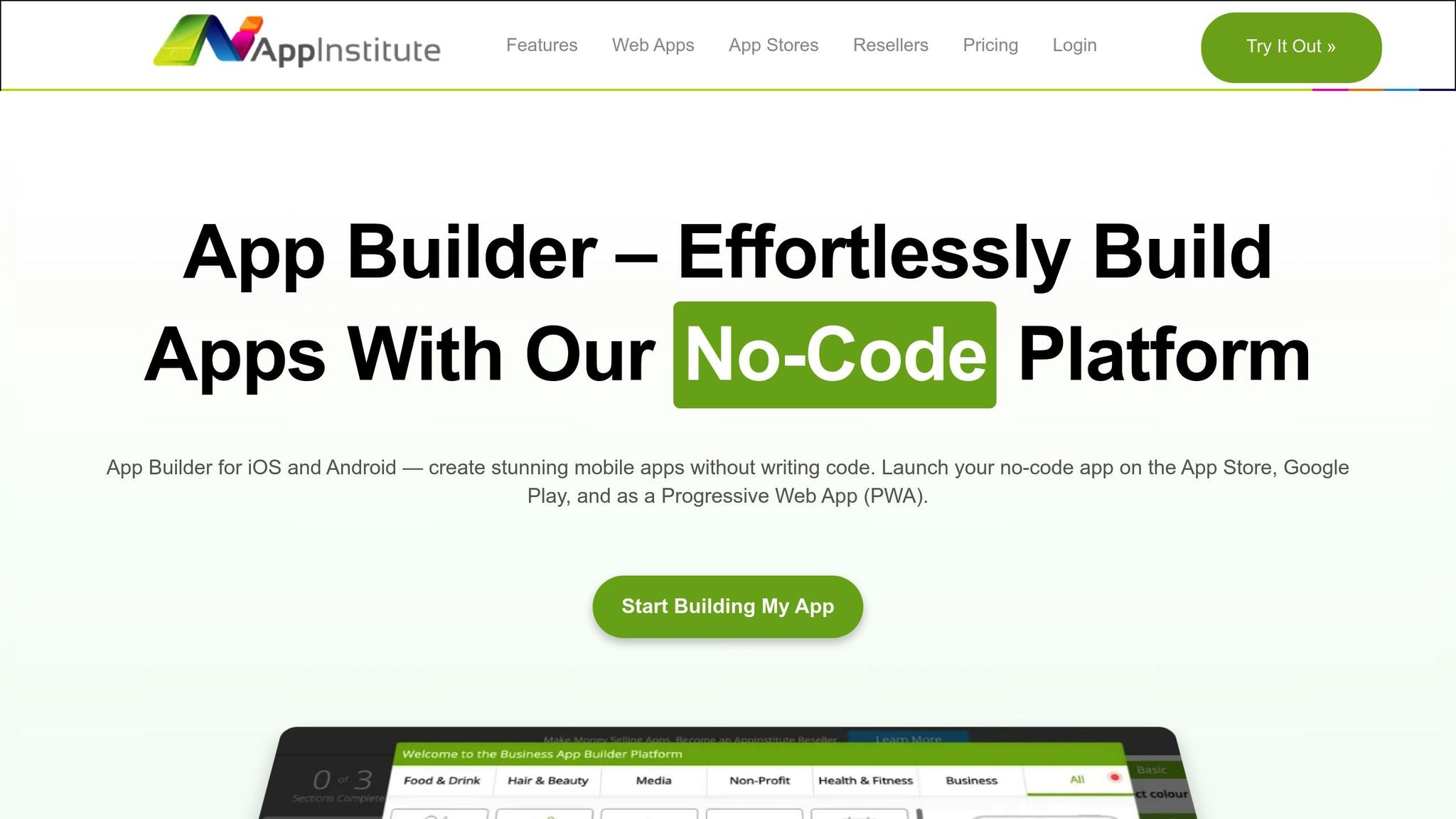
To support ongoing retention efforts, platforms like AppInstitute make it easier to implement changes quickly. With its no-code platform, even non-technical teams can move fast. AppInstitute’s drag-and-drop editor allows you to tweak PWA features, adjust layouts, and preview changes instantly – no coding required. This means you can test ideas like simplifying your onboarding process or reorganizing your home screen in hours rather than weeks, and roll out updates immediately.
You can also experiment with notification timing, messaging, and frequency based on cohort performance data. By deploying changes instantly, you can run more experiments in less time, allowing you to refine your approach and build on small retention gains over multiple iterations.
To keep this process on track, designate someone as the “retention owner.” This person should review retention dashboards weekly, prioritize experiments, and oversee rollouts. When done consistently, this approach ensures retention improvement becomes part of your routine, leading to long-term gains that grow over time.
Conclusion
Retention metrics are the heartbeat of your PWA’s success, offering a clear picture of how well you’re keeping users engaged over time. Metrics like retention rate, churn rate, and stickiness go beyond just tracking installs or downloads – they reveal whether users are coming back, which is far more valuable in the long run. Higher retention doesn’t just mean happier users; it translates into greater lifetime value, more stable revenue streams, and better marketing ROI. And for businesses in competitive U.S. markets, retaining users is almost always more cost-effective than acquiring new ones.
To truly thrive, retention needs to be treated as an ongoing process. Regularly measure cohort retention (e.g., Day 1, Day 7, Day 30), pinpoint where users drop off, and experiment with improvements like onboarding tweaks or push notification strategies. Then, measure the results and refine again. Even small, steady improvements – like increasing your 30-day retention from 15% to 20% – can lead to significant business gains over time. As the saying goes, “what gets measured improves”, and consistent tracking is key to driving growth.
Modern analytics tools make this process easier than ever. Platforms like AppInstitute offer ready-to-use dashboards for monitoring retention, churn, funnels, and cohorts. Their no-code, drag-and-drop solution empowers small businesses to build PWAs, integrate push notifications, manage users, and test retention strategies in mere hours instead of weeks. With tools like these, taking action on retention insights becomes seamless. For best results, schedule monthly reviews to analyze your retention data and plan your next experiment. The most successful PWAs in the U.S. approach retention as an ongoing, integral part of their product strategy, and AppInstitute equips even small businesses to do the same. By applying these strategies and leveraging the right tools, your PWA can achieve the retention levels needed for long-term growth.
FAQs – PWA Retention
What are the best strategies to boost retention for a Progressive Web App (PWA)?
To boost PWA retention, focus on delivering a fast and enjoyable user experience. Make sure your app loads quickly, operates smoothly, and offers easy-to-navigate features. Adding a personal touch, like push notifications tailored to user interests, can keep users engaged by offering timely and relevant updates.
Keep your PWA fresh by rolling out regular updates with new content and features. Leverage analytics tools to gain insights into user behavior and pinpoint opportunities for improvement. A well-thought-out onboarding process, such as simple, step-by-step tutorials, can help new users grasp the app’s benefits right away – making them more likely to stick around.
How can engagement metrics help improve my PWA’s performance?
Understanding engagement metrics like user retention, session duration, and feature usage can reveal where users lose interest or stop interacting with your app. These numbers can point to potential issues, such as confusing navigation, features that don’t perform well, or content that fails to capture attention.
By digging into this data, you can make smarter decisions to improve your app. Whether it’s simplifying navigation, fine-tuning features, or making content more engaging, small, focused updates can make a big difference. These tweaks not only enhance the user experience but can also lead to higher satisfaction and better retention rates.
Why should you analyze retention data based on how users find your app and their behavior?
Understanding retention data by acquisition channel and user behavior gives you a clearer picture of which marketing strategies attract the most engaged users. With this knowledge, you can fine-tune your efforts, prioritize the channels that work best, and craft personalized experiences that encourage users to stick around.
Spotting trends in how users interact with your product also helps you tackle problem areas, improve features, and offer more value. The result? Happier users who are more likely to stay loyal over time.
Related Blog Posts
- How to Build Responsive PWAs Without Code
- Ultimate Guide to PWA Push Notifications
- Checklist for PWA Performance Before Deployment
- Checklist for Optimizing PWA Caching Strategies
Last Updated on December 12, 2025 by Becky Halls
0 thoughts on “Retention Metrics for PWAs: Ultimate Guide”