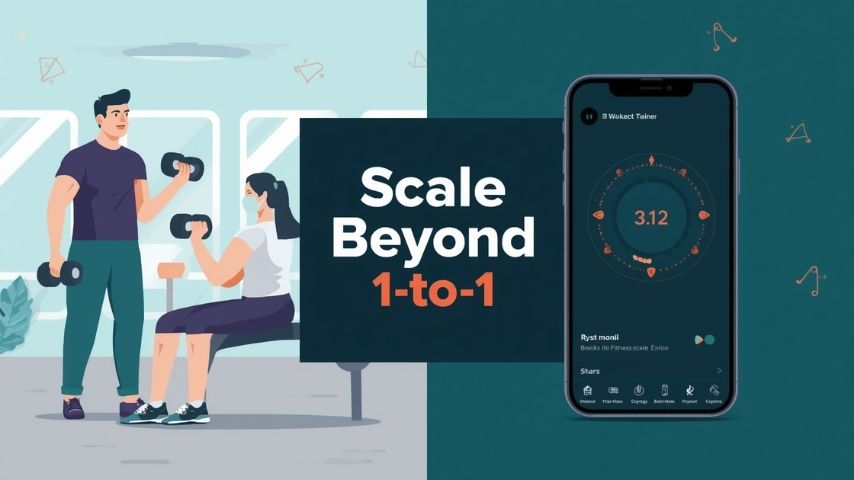
Let’s start with a truth every personal trainer feels in their knees by 6pm: there are only so many hours in the day, and you can only stand next to so many people counting reps before your body files a formal complaint.
If your income is 100% tied to how many sessions you can physically deliver this week, you don’t have a business. You have a very sweaty job with a cap on it. And when you get injured, catch a cold, or dare to take a holiday, the money stops the second you do.
The good news? 2026 is arguably the best year yet to break that cap, and you don’t need to open a second gym or clone yourself to do it. You need to move some of your genius off your shoulders and into your clients’ pockets. In other words: your own branded app. So if you’ve been wondering how to scale a personal training business without adding a single hour to your week, this one’s for you. Let’s get into the questions people are actually Googling at 11pm after a fully booked day.
Why is the 1-to-1 personal training model so hard to grow?
Because it’s the only business on earth where doing well means running out of the thing you sell: your time.
Think about it. You get better, you get busier, your diary fills up, and then… that’s it. You’ve hit the ceiling. The only levers left are raising your prices (there’s a limit before clients wince) or getting up at 4:30am to squeeze in more bodies (there’s a limit before you wince).
One-to-one income is also fragile. It’s directly tied to hours worked, which leaves trainers exposed during injury, illness, or a well-earned week in the sun. No session, no money. That’s a scary way to run your life when you’re the whole product.
The trainers who are actually building something durable in 2026 have stopped selling only their hours and started selling their system: their programming, their accountability, their community. That shift, from selling time to selling a system, is the real answer to how to scale a personal training business, and an app is how you package all three so they work while you sleep.
“Every trainer I meet is brilliant at coaching and terrible at cloning themselves. An app is the closest thing to being in two places at once. Your programme, your voice, your accountability, all running in the background while you’re actually training someone in person.” (Ian, AppBuild.diy)
What does it actually mean to “scale beyond 1-to-1”?
It means building income layers that don’t need you standing there in real time. The big three:
Online and hybrid coaching. Instead of only selling in-person slots, you deliver programmes, check-ins and form feedback through an app. This is now the default, not the fringe. Roughly 48% of coaches run a hybrid model (both in-person and online) as their main setup, and online delivery captures around 45% of the global market, according to Trainerize’s 2026 personal training industry statistics. The lone in-person-only trainer is now the minority.
Recurring memberships. Monthly packages instead of “10 sessions then we’ll see.” This one change is quietly enormous: trainers who switch to monthly packages see 30 to 50% higher revenue per client, per that same Trainerize data. Same clients, more predictable income, less time chasing rebookings.
On-demand products. Recorded workout programmes, a “train at home” plan, a nutrition guide, a beginner’s onboarding course. You build it once, and it sells while you’re asleep, on holiday, or deadlifting with a client.
Stack those on top of your premium in-person slots and suddenly your income isn’t a straight line capped by your calendar. It’s got layers. Layers that keep paying you even during the weeks you physically can’t.
Do I really need my own app, or is Instagram enough?
Ah, the eternal question. Look, Instagram is a lovely shop window. But you don’t own it, the reach is a lottery, and you’re one algorithm tantrum away from your “audience” never seeing you again. Try running a paid 12-week programme purely through DMs and story replies and you’ll lose your mind (and probably a few payments) by week two.
A branded app is the difference between renting attention and owning a relationship. Your clients download your app, with your name on the home screen, and everything lives in one place: their programme, their check-ins, their progress photos, the payment, the push notification that nudges them to actually show up. No lost DMs. No “sorry, which workout did you mean?” No spreadsheet held together with hope.
“People think an app is a tech project. It isn’t. It’s a boundary. Your clients stop texting you at 10pm because everything they need, the plan, the payment, the little nudge, is already sitting in the app with your logo on it. You get your evenings back.” (Becky, AppBuild.diy)
And no, you don’t need to be a developer or remortgage the house. No-code builders like AppBuild.diy exist precisely so a busy trainer can build and launch a proper app without touching a line of code or hiring an agency.
How does an app actually make me more money (not just more admin)?
Fair challenge, because the last thing you need is another dashboard to babysit. Here’s where the real money hides:
It plugs the churn leak. Fitness is a leaky bucket, clients drift off when motivation dips. An app with habit tracking, streaks, and the odd well-timed push notification keeps people engaged between sessions, which keeps them paying. Retention is cheaper than constantly replacing clients who quietly vanished.
It sells the extra layers for you. Once clients are in the app, upselling a nutrition add-on, a summer challenge, or a friend’s referral is a tap away, not an awkward sales pitch.
It lets you take on more clients per hour. Ten online clients on a monthly plan don’t need ten separate hours. Your programming does the heavy lifting; you just review and nudge.
It rides the AI and wearables wave. This is the trend worth leaning into for 2026. The smart fitness market (AI-powered kit, wearables and connected platforms) is projected to hit around $42.15 billion in 2026, growing at an eye-watering 25.9% a year. Clients now show up with heart-rate, sleep and recovery data on their wrists and expect you to use it. The winning model isn’t AI replacing you, it’s AI handling the data-crunching and admin while you do the bit no algorithm can fake: motivation, empathy, and telling someone their squat depth is a lie with love.
“The trainers pulling ahead aren’t the ones with the fanciest tech. They’re the ones who let the app do the boring stuff, the reminders, the tracking, the payments, so they can spend their actual energy coaching humans. Automate the admin, keep the heart.” (David, AppBuild.diy)
What’s the trending fitness model I should pay attention to in 2026?
Hybrid. Full stop.
The pattern that’s winning is clients doing convenient sessions at home or in the app on quiet days, then coming in for periodic in-person coaching, social buzz, and the equipment they don’t have in their spare room. It’s not “digital versus in-person.” It’s both, stitched together, and it consistently earns more per client because the income scales past a fixed weekly schedule.
Your app is the stitching. It’s what connects the Tuesday home workout to the Saturday studio session to the Sunday check-in, all under your brand, all feeding one relationship. Add AI-assisted programming and wearable data on top, and you’ve got an offer that feels genuinely premium, without adding a single hour to your week.
How do I get clients to actually download and use it?
Building it is step one. Getting it onto phones is where trainers get shy, so here are a few tactics that work:
- Make the app the only way in. New programme? It lives in the app. Payment, plan and check-ins all run through it, so downloading isn’t optional, it’s the front door.
- Bribe the first tap (nicely). Offer a free week, a bonus mobility programme, or a nutrition guide that unlocks inside the app. Give them a reason to open it on day one.
- Onboard in person. Get the app on their phone while they’re standing in front of you after a session. “Let’s set up your plan now” beats “I’ll email you a link” every single time.
- Use push notifications like a good coach, not a nag. A nudge before a missed session, a cheer after a PB. Helpful, not needy.
Do that, and the app stops being a gimmick and becomes the thing your clients open every day, with your name right there on their home screen.
How to scale a personal training business – FAQ
Do I need to be tech-savvy to build a personal trainer app? Nope. No-code platforms like AppBuild.diy are built for business owners, not coders. If you can set up an Instagram profile, you can build an app. You focus on the coaching; the builder handles the tech.
How much does a personal trainer app cost compared to hiring a developer? A fraction. Custom development runs into the thousands (often tens of thousands). A no-code app builder is a manageable monthly cost, which is easily covered once you convert even a couple of clients onto recurring memberships.
Will an app replace my in-person sessions? Not at all, and it shouldn’t. Your premium slots stay premium. The app adds new income layers around them (online coaching, memberships, on-demand plans) so you’re not relying on your diary being full every single week.
Can I take payments and memberships through the app? Yes. Recurring memberships are exactly where the predictable, holiday-proof income comes from, and moving clients from pay-as-you-go to monthly plans is one of the biggest levers you have.
Is online coaching actually profitable, or just cheaper for clients? Very profitable when it’s structured as ongoing coaching rather than one-off plans. Hybrid models (in-person plus app) tend to command the highest revenue per client because you’re selling a complete experience, not just an hour of your time.
Last Updated on July 27, 2026 by Becky Halls
0 thoughts on “How Do Personal Trainers Escape the Time-for-Money Trap in 2026?”