So you have decided to sell apps – we obviously think this is the best idea!! You’ll have recurring revenue, your brand on the box, clients who stick around because their whole loyalty programme lives inside the thing you built them… But how do you choose a white-label app reseller platform?
When you open Google and search “best white label app builder for resellers”, you get hit with a wall of platforms all claiming to be the “#1 white-label app reseller platform” over identical stock photos of someone pointing at a laptop. This is not helpful and won’t help your career!
But, choosing a white-label app reseller platform is not that hard once you know which questions to ask. Most of them struggle on the same three or four things. Ask the right questions up front and you skip the expensive mistakes, the ones where you have already put your logo on it and told a client “yes, absolutely” before finding out the platform cannot do the one thing that mattered… Let’s go through the questions that separate a real reseller platform from a pretty login screen.
What is a white-label app reseller platform, exactly?
A white-label app reseller platform is software that lets you build mobile apps for your clients and sell them under your own brand, not the platform’s. The client never sees the vendor. They see you: your logo, your login screen, your domain (something like apps.youragency.com), your invoice. You pay one licence fee to the platform, you charge your clients whatever you like, and you keep the difference every single month.
Think of it like a coffee brand that does not own a farm. You are not roasting beans in a shed, you are putting your label on a very good supply chain and building a business on top of it. You do the client relationship, the pricing and the branding. The platform does the boring, expensive engineering. That is the model. Now, the questions.
How do you actually make money reselling white-label apps?
This is the whole point, so let’s do the maths and not be shy about it.
The competition here is bespoke development. If a small business wants a proper native app built from scratch across iOS and Android, they are looking at roughly £15,000 to £40,000 per app, and that is before the 15 to 20 percent a year they will pay to keep it maintained. Per app. For one client.
A reseller platform flips that. With AppBuild.diy’s reseller partner programme, you pay one flat platform licence of $599 a month (or a discounted annual, around $4,999 up front) and that covers up to 50 customer apps. Not one. Fifty.
So the recurring-revenue engine looks like this: charge each client £99 a month for their app, sign up 15 clients, and you are bringing in around £1,485 a month against one $599 licence. Everything past your break-even is margin, and it lands whether you are working or on a beach. This is not a wild claim, either. One industry write-up notes that solo consultants are adding $800 to $2,000 in recurring revenue from just 8 to 15 white-label clients, and lead-gen agencies are layering five figures a month of branded software on top of their retainers.
That gap, one flat licence against tens of thousands per bespoke build, is the entire reason this business exists.
“Agencies do not lose deals because their design is worse. They lose them because bespoke app quotes make small business owners laugh and close the tab. Reselling lets you say yes at a price they can actually afford, and still keep a healthy margin.” Ian Naylor, Founder, AppBuild.diy
What should you look for when choosing a white-label app reseller platform?
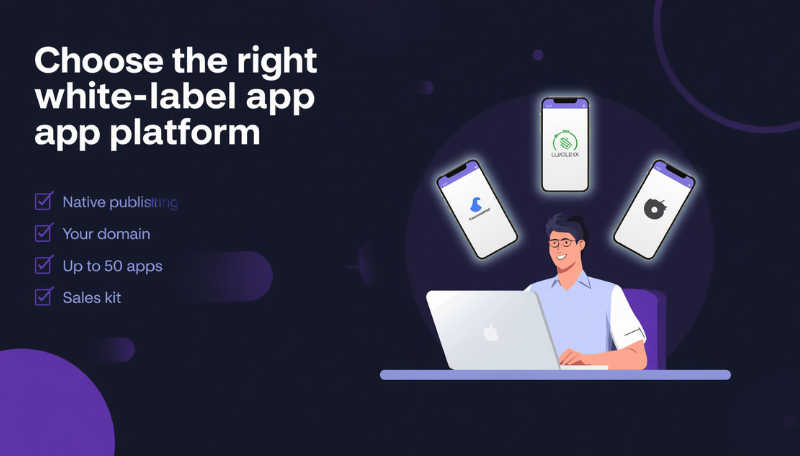
Here is the checklist. Print it, screenshot it, whatever. When you are comparing platforms, score each one on these:
True white-label depth. Not just “add your logo”. Can you use your own domain? Your own login screen? Does the client dashboard say your name or does the vendor’s brand leak through somewhere on page four? If the platform’s name shows up anywhere the client can see, it is not really white-label. It is beige-label.
Native publishing. This is the big one, and it is where a lot of “app builders” turn out to be web-page builders in a trench coat. Can it publish real native apps to the Apple App Store and Google Play, or does it just spit out a web app or a PWA that lives in a browser? If your client cannot search their own name in the App Store and find their app, you are going to have an awkward phone call. Native publishing plus push notifications is the difference between a real app and a bookmark with ambitions.
How many apps are included. Some platforms charge per app, which sounds fine until you have 12 clients and your costs have sneakily, sorry, steadily crept up to match your revenue. A flat licence covering up to 50 apps means your costs stay put while your income climbs.
A pricing model you can predict. Look for the ceiling. If the page says “need more than 50 apps? Talk to us”, find out the number before you sign, not after you have built a growth plan around a cost nobody will name.
Payments and infrastructure. Can clients actually take money in the app? AppBuild.diy handles payments through Stripe, Apple Pay and Google Pay, with hosting and security on Cloudflare, so you are not stitching that together yourself at midnight.
A sales kit. The honest objection is rarely “can this platform build an app”. It is “can I actually sell this”. The best programmes hand you the answer. The AppBuild.diy reseller partner programme includes a rebrandable pitch deck, a pricing sheet, industry demo apps, a four-email outreach sequence and an objection-handling one-pager. That is the stuff that gets you from “signed up” to “first invoice sent”.
“The platform you pick is really a bet on your next three years of income. Test it like one. Build a demo app in the free trial, put your own branding on it, and imagine sending it to your fussiest client. If you flinch, keep looking.” Becky Halls, Strategist, AppBuild.diy
Which white-label app builders should you compare?
The names that come up most are Bizness Apps, Swiftic, GoodBarber’s white-label offering, and AppBuild.diy by AppInstitute. Do not take anyone’s comparison table at face value, including this paragraph. Build your own: put the platforms in a spreadsheet and score each on the checklist above.
The comparison matters because this market is filling up fast. The low-code and no-code market is projected to reach around $52 billion in 2026, and every AI vibe-coding tool under the sun is now telling small businesses they can build their own app in an afternoon. They can build something. Getting it into the App Store, keeping it updated and making it feel native is a different job, and that job is exactly what you are selling. Pick a platform that does the hard part properly and you have a real moat.
Do you need to know how to code to resell apps?
No. That is genuinely the point of the whole thing. A proper white-label reseller platform means no coding, no dev team, no late nights reading Stack Overflow with a cold cup of tea going scummy beside you.
You handle the client, the branding and the pricing. The platform builds the app, publishes it to the stores and keeps it running. If you can use Canva and send an invoice, you can run a white-label app business. Web designers, marketing and digital agencies, freelancers, VAs, consultants and side-hustlers are all doing exactly this, precisely because the technical barrier has been removed.
How fast can you actually start selling?
Faster than you would think, and it is worth checking before you commit. Look for a free trial (AppBuild.diy gives you 7 days) so you can build something real before spending a penny. A sensible first fortnight: day one, point your domain and get SSL live; day two, drop in your logo, colours and login screen; day three, build your first app; day seven, demo it to a client using their real branding; day 14, send your first invoice. That is a two-week runway from “signed up” to “getting paid”, against the six-to-nine months a bespoke build would eat.
What are the red flags to avoid?
A few things that should make you close the tab: apps that are secretly just web pages (no genuine native App Store and Google Play publishing means it is a mobile-website business wearing a lanyard); per-app pricing with no ceiling (fine at three clients, painful at thirty); “white-label” that leaks the vendor’s brand where the client can see it; and no sales support, which means you are buying software, not a business. And the classic: a demo that will not let you use your own branding. If you cannot make it look like yours during the trial, assume you never will.
“Resellers do not fail because the software was bad. They fail because they picked a platform that could build an app but could not publish it, or could not be branded, and they found out in front of a client. Choose for the moment the client is watching, not the moment you sign up.” David Hall, CEO, AppBuild.diy
Choose a white-label app reseller platform – FAQs
What is the best white-label app builder for resellers in 2026? The best one is the one that does true domain-level white-labelling, publishes real native apps to the Apple App Store and Google Play, includes a generous number of apps in a flat licence, and gives you a sales kit. Compare Bizness Apps, Swiftic, GoodBarber, AppInstitute and AppBuild.diy against that checklist rather than trusting any single vendor’s marketing.
How much does a white-label app reseller platform cost? It varies. AppBuild.diy uses a flat licence of $599 a month covering up to 50 customer apps, or roughly $4,999 for an annual plan. Watch for platforms that charge per app, because those costs scale with your success rather than staying fixed.
Can I really sell apps without knowing how to code? Yes. The platform handles the build, the native publishing and the maintenance. You handle branding, pricing and clients. No dev team required.
Do the apps actually go on the App Store and Google Play? On a proper platform, yes. AppBuild.diy publishes native iOS and Android apps to the Apple App Store and Google Play under your clients’ branding. This is the single feature most worth checking before you buy.
Ready to test one properly?
The fastest way to judge a white-label app reseller platform is to build something in it with your own branding and see if you would proudly send it to a client. You can do exactly that on the AppBuild.diy reseller partner programme with a 7-day free trial, the full sales kit, and up to 50 apps under your own name. Kick the tyres, build a demo, run the numbers through the ROI calculator, and see whether the maths makes you smile.
Choose well and you are not buying software. You are buying the next three years of recurring income with your logo on it.
David, CEO at AppBuild.diy by AppInstitute
Last Updated on September 29, 2026 by Becky Halls
0 thoughts on “How to Choose a White-Label App Reseller Platform in 2026”