Something flipped for creators this year – For about a decade the whole job was reach. Chase the algorithm, feed it daily, hope it decides to show your new video to the people who already followed you. In 2026 a lot of creators stopped playing that game and started a different one, and they’re building things they actually own.
And the numbers back it up. Circle’s 2026 Community Trends Report found paid memberships among creators jumped from 54% to 88% in a single year. The share of creators who say new members find them through social apps slipped to 67%, down from 76% the year before. Read that as what it is: creators are leaning away from borrowed reach and toward audiences they can keep.
A branded creator app is the sharp end of that shift. So let’s talk about why, and whether it’s actually worth it for you (even if you’re nowhere near MrBeast numbers).
What does “owning your audience” actually mean?
It means you have a direct line to your fans that nobody else controls.
Right now, think about how you reach the people who like your stuff. You post and pray. YouTube decides whether the bell notification fires. Instagram shows your Story to maybe a third of your followers on a good day. Twitch pings people when you go live, if they’ve got the right settings, if they’re on the app, if the stars align. You built that audience. But you don’t hold the keys to it.
With your own creator app, when someone downloads it, they’re yours. You can reach every single one of them, whenever you want, for free. No gatekeeper deciding you’re not “engaging” enough this week. That’s the difference between following and owning.
“Creators spent ten years renting their audience from platforms that could change the rules any morning. An app is the first thing in that whole stack they genuinely own, and ownership is the only thing that compounds.” Ian Naylor, Founder at AppBuild.diy by AppInstitute.
Why is the algorithm a bad landlord?
Because a landlord can raise the rent, change the rules, or evict you, and there’s nothing you can do about it.
I think most creators have had the moment where a platform tweaks something overnight and their views fall off a cliff. Reach gets throttled. A format stops working. An account gets hit with a strike for no clear reason and support is a wall of canned replies. You built your whole livelihood on a platform somebody else owns, and overnight they changed the terms.
The livestreaming world alone is enormous, so plenty of careers ride on platforms their owners fully control. Twitch pulled 4.51 billion hours watched in Q3 2026 according to Streams Charts. That’s a staggering amount of attention flowing through platforms you don’t control. The creators who sleep well are the ones building a bolt-hole off-platform, so if one channel goes dark tomorrow, they can still reach their people.
Your app is that bolt-hole. It sits on the fan’s home screen next to WhatsApp and the banking app. It can’t be deranked. It doesn’t care what the algorithm had for breakfast.
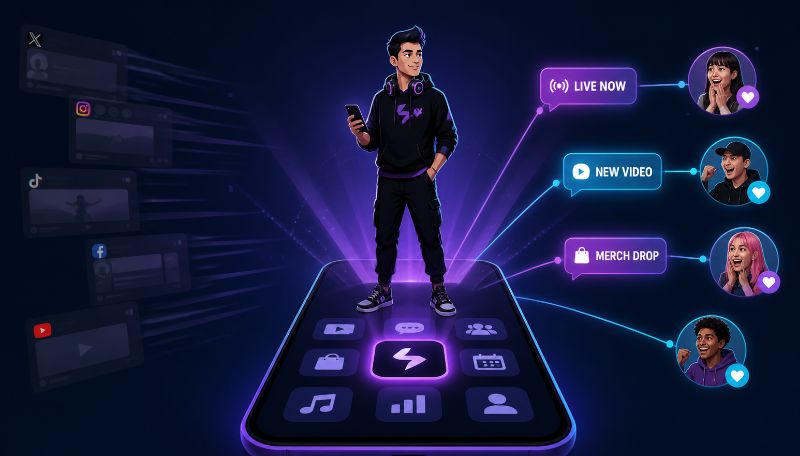
How does a push notification beat the YouTube bell?
Simple: it actually arrives, and it costs you nothing to send.
The YouTube bell and the Twitch “live” ping are rationed. The platform decides who gets them and how often, because too many notifications send people running for the settings. You’re one creator competing with every other channel that person subscribed to.
A push notification from your own app is different. “I’m live right now, come hang out.” “New video just dropped.” “Merch restock, 50 left.” It lands on the lock screen of everyone who downloaded your app. Nobody’s bidding for that attention, and there’s no per-message fee eating into it either, which matters, because AppBuild.diy gives you unlimited free push. Send one to five hundred people or five hundred thousand, the price is the same. Zero.
That’s the bit that makes creators sit up. Email open rates are soft. Social reach is a lottery. A push notification tapping a fan on the shoulder the second you go live? That’s a crowd walking into your stream before the intro music finishes.
Can an app actually make you money, or is it just a vanity thing?
It can make you real, repeatable money, and that’s the whole point.
Platform revenue is lumpy and someone else always takes a slice. Twitch takes its cut of subs. YouTube takes its cut of ads. Sponsorships come and go with the seasons. None of it is yours to control.
An app flips that. Put your best stuff behind a membership and charge for it directly through Stripe. Early access to videos. A members-only live. Behind-the-scenes. A monthly community where your real fans actually talk to each other instead of shouting into a comment section. That’s recurring income that lands in your account, not a platform’s, and you set the price.
Sell merch through the app too. Run a drop as a push notification and watch it move. Pull your Instagram, X and YouTube feeds into one tidy home so a new fan sees everything you do in one place, and design the thumbnails and banners in Canva without hiring anyone. The app becomes the hub. Everything else becomes a funnel pointing at it.
“The push notification is the magic bit for creators. You go live, you tap send, and your real fans are walking into the stream before the algorithm has even noticed. No one’s rationing your reach anymore.” Becky Halls, Strategist at AppBuild.diy by AppInstitute.
Isn’t this only worth it for massive creators?
No, and honestly it’s often the opposite.
The big names have teams, Discord mods, a newsletter, a merch ops person. If you’re a solo creator or a small channel, you’re doing all of that yourself at 1am. An app pulls the mess into one place so you’re not juggling six platforms and a spreadsheet.
And you don’t need to be famous for it to pay. A creator with 3,000 genuine fans who’ll pay a few quid a month for a members’ community is in a better spot than one with 300,000 passive followers the algorithm barely shows anything to. Owning a small audience beats renting a big one. That membership jump in the Circle report came mostly from ordinary creators who worked out that a direct line beats depending on a feed.
“We built AppBuild.diy so a creator can go from idea to a real app on the App Store and Google Play in about fifteen minutes, no developer, no invoice. Owning your audience shouldn’t need a five-figure budget.” David Hall, CEO at AppBuild.diy by AppInstitute.
How do you build a creator app without code or a developer?
You use a platform built for exactly this, and you’re live the same afternoon.
This used to be the catch. Building an actual app meant a developer, a five-figure quote, and six months of “it’s nearly ready.” So creators defaulted to a link in bio and crossed their fingers.
That’s not the deal anymore. AppBuild.diy lets you build a proper app with no code and no developer, and get it live in about 15 minutes. One build gives you a real native iOS app on the Apple App Store, a native Android app on Google Play, and a web app (PWA), all at once. A listed, downloadable, searchable app with your name on it, the real thing people find in the store and tap to install, not a glorified link in bio.
This is where the shortcut tools fall down. The vibe-coding wave (Lovable, Base44, Bolt, and friends) is brilliant for spinning up a website or a prototype fast. But they can’t publish a genuine native app to the App Store and Google Play, and they can’t send real push notifications to a phone’s lock screen. For a creator, those two things are the entire reason to have an app. So it’s worth knowing the difference before you spend a weekend on the wrong tool.
Build yours on AppBuild.diy by AppInstitute and you’ve got the home screen presence, the push line to your fans, and the membership engine, from one afternoon’s work.
FAQ
Do my fans really want to download another app?
The casual ones won’t, and that’s fine. The app is for your true fans, the ones who’d follow you to a new platform anyway. Those are the people worth owning a direct line to.
What happens to my audience if my channel gets banned or hacked?
If everything lives on one platform, you lose the lot. If your core fans are in your app, you keep the relationship and can tell everyone where you’ve gone. That alone is worth it for a lot of creators.
Can I keep using YouTube, Twitch and Instagram as well?
Absolutely. The app doesn’t replace them, it catches the people they send you so you’re not starting from zero each time. Pull your feeds in and use the platforms as the top of the funnel.
How much does it cost to send push notifications?
On AppBuild.diy, nothing. Push is unlimited and free, however big your following gets. No per-message charge.
I’m not technical. Can I actually do this myself?
Yes. There’s no code involved and it’s built for non-developers. If you can edit a video thumbnail, you can build the app.
Ready to own your audience?
The creators winning in 2026 worked out a simple thing: followers are borrowed, downloads are yours. An app gives you a direct, free, unthrottled line to the people who actually care about what you make, plus a way to earn from them that no platform gets to tax or switch off.
You can have one built and live today. Start building on AppBuild.diy by AppInstitute, send your first push by tonight, and see how it feels to reach your whole audience without asking an algorithm’s permission.
David
Last Updated on November 3, 2026 by Becky Halls
0 thoughts on “Why are content creators building their own apps in 2026?”