Here is a pattern every physio and chiropractor knows well… A new patient hobbles in, clearly in pain, nodding along as you explain that this is a six-session job, not a one-and-done miracle. They book the next appointment… And then somewhere around session two or three, the pain eases just enough, life gets busy, and they vanish. Not because you did anything wrong. They simply felt a bit better and drifted off, exercises half done, recovery half finished.
Then three months later the same twinge is back, except now they are telling their mate “physio didn’t really work for me”.
The thing is, the drop-off is not a people problem. It is a reminder problem, a convenience problem, and a staying-in-touch problem. All three are exactly what a branded physio app from AppBuild.diy is built to fix. Let us walk through how…
Why do so many physio patients vanish before they are better?
Because feeling better and being better are two very different things, and the gap between them is where your revenue leaks out.
Your patient is not thinking about their care plan. They are thinking about the school run, the deadline, and the fact that their shoulder stopped screaming so loudly on Tuesday. Out of sight, out of mind. By the time they rebook, they are usually back at square one (talking from experience here!)
The research backs up just how leaky this is. Studies reviewed on Physiopedia put non-adherence to home exercise programmes at somewhere between 50 and 65 percent for general musculoskeletal patients (physio-pedia.com). Read that again – Up to two in three patients are not doing the exercises that make the treatment work. No wonder they plateau and drift!
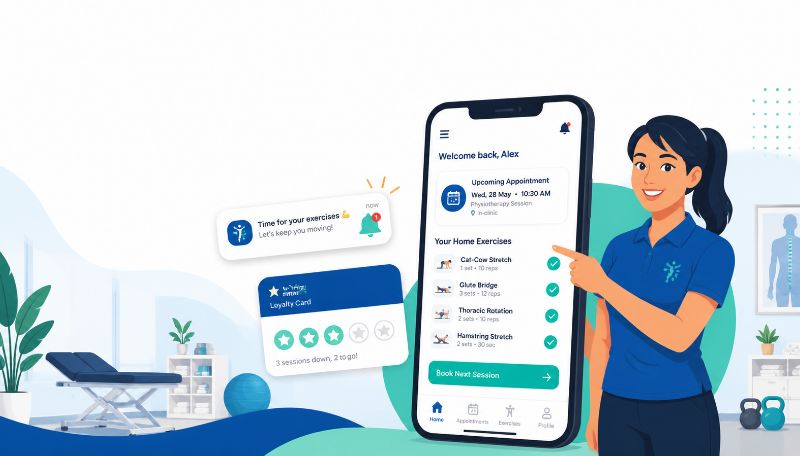
A physiotherapy clinic app closes the gap because it keeps you in your patient’s pocket between visits, not just in the room during them. With AppBuild.diy you send unlimited free push notifications, so a gentle “You’ve got two sessions left on your plan, shall we lock in the next one?” costs you nothing. Not per message, not per hundred. Nothing. That is a very different world from rationing SMS credits and hoping the letter lands on the right day.
“Clinics have always had the skill. What they have lacked is a way to stay present when the patient walks out of the door. An app finally gives a single practice that always-on connection.” Ian Naylor, Founder at AppBuild.diy by AppInstitute
What costs you more: the no-show or the non-finisher?
Both, and they are closely related. A no-show is one empty slot you cannot resell. A non-finisher is an entire care plan of lost sessions, plus the referral they never made and the “it didn’t work” review they might.
Missed appointments alone are brutal across healthcare. Research from Warwick Business School found around 5.5 million NHS outpatient appointments were missed in a single year, each one costing roughly 160 pounds, and that simply stating the cost in a reminder text cut the did-not-attend rate by about three percentage points (wbs.ac.uk). Now picture that reminder running automatically, for free, through your own app.
Let patients book and rebook their own sessions in the app, 24 hours a day, including the 11pm “my back has gone again” moment that your closed reception desk can never catch. AppBuild.diy by AppInstitute plugs straight into the booking tools you may already run, think Acuity Scheduling, Square Appointments, Calendly or Google Calendar, so your diary stays in sync and nobody gets double-booked. Add a morning reminder push, a one-tap confirm, and a small deposit through Stripe for new or private patients, and the empty-chair problem shrinks fast.
How do you keep patients doing their exercises between appointments?
This is the big one, because home exercises are where recovery actually happens. The forty minutes in your clinic are the easy part. The other six days of the week are where plans succeed or fall apart.
An app turns the home programme from a creased sheet of paper (lost by Thursday, honestly) into a living prompt on the device they check 90 times a day. A short push at the time they said they would do their exercises. A quick “how is the knee feeling today?” check-in that makes them feel looked after rather than nagged. A reminder that this week’s goal was three sets, not zero.
There is good evidence that fewer, clearer exercises beat a long overwhelming list, so keep the programme tight and let the app do the chasing. Every nudge you send is one more rep done, one less plateau, and one more patient who gets properly better and tells everyone you are a miracle worker. Which, frankly, you are. You just needed a way to be in the room when you are not in the room.
“The clinics that win are not the ones with the fanciest treatment table. They are the ones that show up on the right phone at the right moment, for free, and keep patients on track until they are actually better.” Becky Halls, Strategist at AppBuild.diy by AppInstitute
Can an app turn a one-off injury into a long-term care relationship?
Yes, and this is where the clever clinics pull ahead. A sore back is a transaction. A patient who sees you as their go-to for the whole body, forever, is an asset.
Put a maintenance plan or membership in the app, paid automatically through Stripe. Monthly MOT for the runners, the desk-hunched office crowd, the weekend warriors who will absolutely do something daft again. Stack a simple digital loyalty card on top (nobody loses the app the way they lose the little paper card in the glovebox), and you have turned sporadic injury visits into predictable monthly income.
Then keep the relationship warm with useful, seasonal push messages rather than salesy ones. A “desk posture reset in 60 seconds” tip in January. A “getting back into running? read this first” nudge in spring. Pull your graphics together in Canva, drop them in Facebook and Instagram too, and let the email side tick over through Mailchimp. Social is rented land though, so the app is the one channel where your patients are genuinely yours.
Why does being on the App Store matter for a physio or chiro clinic?
Because trust is everything when someone is handing you their spine, and a real app on the Apple App Store and Google Play is a trust signal that a link in an Instagram bio will never match.
This is where AppBuild.diy by AppInstitute stands apart. We build fully native iOS and Android apps and publish them to both the Apple App Store and Google Play, plus a PWA, all from one build. No developers, no code, and you can be live in about 15 minutes. The vibe-coding tools and website-wrapper platforms doing the rounds right now cannot publish a true native app or send real push notifications, which, for a clinic that lives on reminders and recall, is the whole point.
Your patient searches your clinic name, finds your actual app sitting there looking professional, downloads it, and now you are a permanent icon on their home screen. Not a half-remembered name on a crumpled appointment card.
How do you fill the diary in the dead winter weeks?
Physio and chiro have a rhythm, and winter is a strange one. Cold stiffens joints, dark evenings kill activity, slippery pavements produce a steady supply of new patients, and desk posture goes to pot when nobody wants to get up and move. Then January arrives with the resolution crowd who hit the gym far too hard and tweak everything.
Ride all of it with push. A November “stiff and achy in the cold? here is why and what helps” message. A January “new to the gym? don’t let enthusiasm become an injury” nudge with a check-up offer. And in the genuinely flat weeks, a “we have a cancellation at 3pm today, first to tap it gets it” push keeps your treatment table warm when it would otherwise sit empty. The freed slot gets filled before lunch, for free, instead of costing you a wasted afternoon.
Frequently asked questions
Do I need to be technical to build a physiotherapy clinic app?
Not at all. AppBuild.diy is no code and no developers. You choose your look, add your details, connect the tools you already use, and you can be live on the App Store and Google Play in about 15 minutes. If you can run a clinic, you can run this.
Will it work with my existing booking and payment systems?
Yes. It connects to scheduling tools like Acuity Scheduling, Square Appointments, Calendly and Google Calendar, takes payments, deposits and memberships through Stripe, and plays nicely with Mailchimp for email and Canva for your graphics. You are adding a front door, not ripping out your plumbing.
How much do the push notifications cost?
Nothing per message. Unlimited free push is included, which is exactly why an app beats rationed pay-per-send SMS for exercise reminders, recall and cancellation fills.
Can it really help with home exercise adherence?
It gives you the one thing paper never could: a reminder that lands at the right moment on the device the patient always has on them. You still prescribe the programme. The app just makes sure they remember to actually do it.
Is it a proper app or just my website in a wrapper?
A proper one. Fully native iOS and Android apps published to the Apple App Store and Google Play, plus a PWA, from a single build. That native status is what makes real push notifications and App Store credibility possible.
Last Updated on November 4, 2026 by Becky Halls
0 thoughts on “Why Half Your Physio Patients Disappear Before They’re Better – And How an App Fixes It”