Running an inspection or examination business is really a deadlines business. Every crane, hoist, extinguisher, harness and test instrument on your books has a date it has to be re-checked by. Miss that date and your customer is the one holding the risk: kit that is illegal to use, a lapsed certificate, an insurer who stops wanting to know. So the whole job comes down to one question. How do you make sure nothing slips past its due date?
A branded app is the cleanest answer I have seen. Not a wall planner, not a shared spreadsheet, not a drawer full of reminder letters. An app that knows every piece of equipment you look after, pings the customer when it is due, points them at the exact item, and lets them book the re-check in a couple of taps.
Let me show you what that looks like in a few real trades, starting with one I know well…
Why do inspection businesses live or die by due dates?
Because the dates are not suggestions – They are the law, and they repeat forever.
Let’s take lifting equipment – Under LOLER, the HSE sets out that thorough examinations should happen every 6 months for anything used to lift people and for all lifting accessories, and every 12 months for other lifting equipment, unless an examination scheme says otherwise. Work equipment has its own rhythm under PUWER. Fire extinguishers get an annual service. Gas appliances in a rented property need a check every 12 months. Different trades, same shape: a recurring date that, if missed, turns a compliant customer into an exposed one.
That is the gift and the curse of the work. The repeat business is baked in. But so is the admin, and a spreadsheet does not tap anyone on the shoulder when a date creeps up.
What does this look like for a LOLER examiner?
My first example is PULO Compliance, a lifting-equipment examiner over in the East Midlands. Ryan carries out and signs every thorough examination himself, he does not sell, hire or repair the kit, and he sends every customer a reminder before each examination is due. That reminder is the relationship. It is the reason the customer stays compliant and the reason they stay with Ryan.
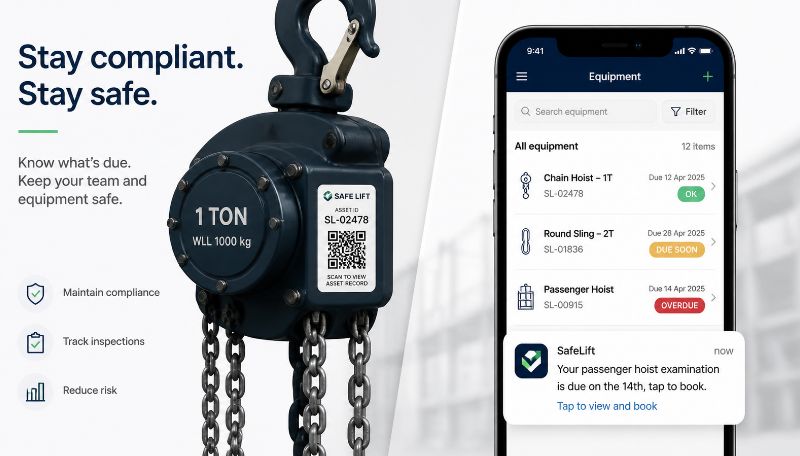
Now picture that promise running inside an app instead of out of a diary and a sent-items folder. Every customer’s gear is logged: that 6-monthly passenger hoist, those 12-monthly chain slings, each with its own next-due date. Four weeks before a date lands, the app fires a push: “Your passenger hoist examination is due on the 14th, tap to book Ryan in.” No letter to print, no date to remember, no customer slipping through because the diary reminder got buried under a busy week.
The examiner keeps doing the skilled bit, the examination and the signature. The app does the nagging, reliably, forever.
What about fire safety, PAT testing and gas?
Same engine, different kit. This is where the model earns its keep across trades.
A fire safety firm tracks extinguishers, alarms and emergency lighting across dozens of sites, each on its own service cycle. A PAT tester keeps a register of a customer’s appliances and re-tests on a risk-based schedule. A Gas Safe engineer runs a book of landlords who each need a certificate renewed every 12 months. Air-conditioning engineers have F-gas checks. Playground inspectors have annual RPII inspections. Tree surgeons have survey cycles.
Every one of them is sitting on a list of items with due dates that need booking and a customer who would honestly rather be reminded than fined. The app is the same idea each time: the register, the reminder, the booking, in one place with your name on it.
How do the equipment tags actually work?
This is the part that makes customers trust it. Give every item its own entry in the app, with a simple asset number or a QR sticker stuck on the kit itself.
The customer scans the sticker or opens the item in the app and sees the lot: the last certificate (stored as a PDF they can actually find when their auditor asks), the next due date, the examination history, and a Book button. When the reminder push goes out, it links straight to that item, so they land on the exact hoist, extinguisher or distribution board that needs doing. No vague “something is due,” no digging through a filing cabinet to work out which one you meant.
For you, the same register is a live view of your whole book: what is due this month, who has not booked yet, what is overdue. One gentle follow-up push to the stragglers and your diary fills itself.
Why do push notifications beat letters and texts here?
Because a letter gets recycled and a text costs you every single time you send one.
Push notifications on your own app land on the customer’s lock screen and cost nothing per message, with no cap. That matters when you are sending a reminder four weeks out, a nudge the week before, and a “you are now overdue” alert to the ones who ignored both. Do that by SMS and every message has a price on it, so most firms ration reminders down to one and hope. On your app you can be properly persistent, which is exactly what compliance needs.
Wire in Stripe and the customer can pay a deposit or sign up to a fixed annual plan when they book, so you are not chasing invoices on top of chasing dates. Pull in your existing diary (Acuity, Calendly, Google Calendar or Square Appointments) so bookings drop straight into the calendar you already run. Add your newsletter through Mailchimp for the safety updates and law changes your customers should hear from you, not from a competitor.
Do you need a developer, and how long does it take?
No, and about 15 minutes.
You build it yourself in AppBuild.diy by AppInstitute. No code, no agency, no five-figure quote. Set up your asset register, design it in your colours (Canva graphics drop straight in), connect your booking tool and Stripe, and publish. One build gives you a real iOS app on the Apple App Store, an Android app on Google Play, and a web app (PWA) all at once.
The App Store listing matters more than you might think in this line of work. When a facilities manager is handing you responsibility for kit that could hurt someone, a proper native app says established and serious in a way a link in your email signature never will.
Worth a quick word on the app-builder tools getting a lot of noise right now. Lovable, Base44, Bolt and the like will knock up a web page, and that is fine for a brochure. But they cannot publish a genuine native app to the app stores or send a push notification to a locked phone, which for a reminders-and-bookings business is the entire job. AppBuild.diy does both.
You could have your inspection management app live before your next site visit. Start free at appbuild.diy.
FAQ
Can customers book a re-inspection straight from the reminder?
Yes. The push links to the exact item, and the Book button sits right there, feeding into your existing calendar. Reminder to booked in two taps.
Does it work if I look after hundreds of items across many sites?
That is where it shines. Each item has its own due date and history, grouped by customer and site, so a big register stops being a spreadsheet nightmare and becomes a sortable list of what is due next.
Do the reminders really cost nothing to send?
Push notifications on your own app are unlimited and free per message. That is the difference from SMS, where every reminder has a cost, so you can send the early heads-up, the week-before nudge and the overdue alert without watching a meter.
Can I store certificates in the app?
Yes. Attach the signed certificate or report to each item as a PDF, so your customer can pull up proof the moment an auditor or insurer asks.
I already use a booking system. Do I have to switch?
No. AppBuild.diy sits on top of Acuity, Calendly, Google Calendar or Square Appointments. The app becomes the front door, your diary stays as it is.
Is it only for lifting equipment?
Not at all. Any trade with recurring due dates fits: fire safety, PAT testing, gas, air-con, playgrounds, tree surveys, test instruments, you name it.
Last Updated on November 6, 2026 by Becky Halls
0 thoughts on “What’s the best app for managing inspections and examinations?”