Our write up on this one actually comes from recent personal experience of working with FLOW reformer studio which is a boutique studio offering three locations in Bottesford, Grantham and Bingham (all in the East Midlands, UK) and their struggle for an app that actually worked for their setup.
Reformer Pilates bookings jumped 71% in a year – that is a stampede!! If you run a yoga or pilates studio you have felt it: fuller classes, a waitlist for the 6pm reformer, a fresh wave of faces every January…. BUT do the current booking apps really give you what you want? We’ve looked at the options and whilst they work for some smaller one studio setups, they don’t scale well when you have multiple studios to manage.
The gap, between a packed new-year timetable and a half-empty March, is the whole game for a studio right now. And it happens to be exactly the thing a decent app fixes. Not a booking link buried in your Instagram bio. Your own yoga/pilates app, on the Apple App Store and Google Play, that your regulars tap without thinking.
Let me walk through why, and what to actually do about it.
Why is 2026 the year to get your yoga or pilates studio on an app?
Because demand has never been higher, which means competition has not either.
Pilates was the most-booked workout in the world for the third year running on ClassPass, up 66% year on year, with reformer specifically up 71%. There are now around 5,011 pilates and yoga studios in the UK, growing about 5% a year over the last five. Lovely for the industry. A little nerve-wracking for you, because there is a good chance a shiny new reformer studio opened within driving distance of yours in the last 18 months.
When supply catches up with a trend, the studio that keeps its members wins. The one relying on aggregator walk-ins and crossed fingers at rebooking loses. An app is how you hold the people you have already got.
“The studios pulling ahead in 2026 win on one simple thing: they make rebooking a reflex. The fancy reformers are just furniture.” Ian Naylor, Founder at AppBuild.diy by AppInstitute.
What does an empty reformer bed actually cost you?
More than you would think, and this is the bit the mat-yoga crowd tends to underestimate.
A reformer class is capped. You have maybe 8, 10, 12 beds. When someone books bed 7 and does not show, that seat cannot be resold on the day, the waitlisted person already made other plans, and at £18 to £45 a class you have just waved goodbye to real money. Do that three times a week across your timetable and it stacks up into a proper hole in the month.
A busy open-mat yoga room can absorb the odd no-show. A reformer studio cannot. Scarcity is basically your product, so protecting those beds is the job.
How do you stop no-shows eating your class income?
Two moves, and they work best together.
First, take a card at the point of booking. A small deposit or a pay-upfront policy through Stripe, right inside the app, and the no-show rate drops hard. People turn up for things they have already paid for. I think this is the single biggest lever most studios are ignoring. And you can plug it straight into whatever diary you already run (Acuity, Fresha, Vagaro, Square Appointments, BookedIn), so you are not ripping anything out.
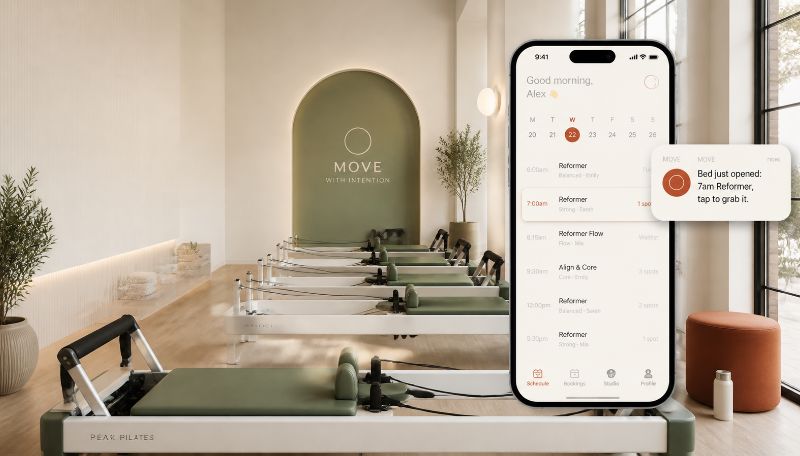
Second, fill the gap the second it opens. Someone cancels the 7am reformer at 9pm the night before. Your app fires one free push message to everyone on the waitlist: “Bed just opened, 7am reformer, tap to grab it.” First to tap wins it. The seat sells itself while you are asleep.
And free matters here. Text messages charge you per send, so most studios ration their reminders down to almost nothing. Push on your own app costs nothing per message, with no cap, so you can actually use it the way it is meant to be used.
How do you keep the January crowd past February?
This is the real prize. Getting January joiners is the easy part. Hanging on to them in March is where studios live or die.
Here is the plan, roughly in order.
- Make the habit visible. An attendance streak, a little “that is 8 classes this month” nudge, the saved usual booking so rebooking is two taps. People stick with the version of themselves they can actually see.
- Catch the quiet ones before they drift. If someone has not booked in 10 days, send one gentle push: “Your shoulders miss us, Tuesday 6pm has space.” Not every day. Just at the moment they are about to slip away.
- Sell the rhythm, not the single class. A monthly membership through Stripe turns a January dabbler into recurring income you can forecast. 40 members at £79 a month is £3,160 banked before you have taught a single drop-in. That is how you flatten the horrible January-to-March slide instead of white-knuckling through it.
And show people their class pack. Most studios sell a 10-class pack, the customer uses three, forgets the rest, and ends up resenting you for it. An app that pops up “you have 6 classes left, book one” turns a dead credit into a booked bed and a happier member. Everyone wins.
“January gets everyone excited. I care about March. An app that nudges the quiet members and shows them the class pack they forgot about is how you turn a new-year fad into a year-round regular.” Becky Halls, Strategist at AppBuild.diy by AppInstitute.
When should you launch, and what about the rest of the year?
Now, honestly, because January is the busiest sign-up window of the year and you want the app in people’s hands before the rush, not during it.
But the app earns its keep long after the resolutions fade. Summer is the sneaky lull (everyone suddenly wants to exercise in a park), so that is when the “we miss you, here is 20% off a bundle” push does its best work. September is a second January as the back-to-routine crowd returns. And Christmas is prime time to sell gift memberships and class packs through Stripe, which parks income on your books for the quiet weeks after. One tool, every season.
Do people really want another app on their phone?
Fair question – and here is the answer: the real pull on your members is the free yoga app already sitting on their phone. Down Dog, a hundred YouTube flows, the lot. The studio down the road barely registers next to it.
So why would they open yours? Because you have the one thing an app cannot give them: a real room, a teacher who remembers their dodgy knee, other humans sweating next to them. Your app is simply the fastest way to book the thing a home workout cannot replace. The booking, the community feed, the “class tonight, two beds left” nudge, all in one tap.
A native app in the App Store also says something a link in your bio never will: this is a proper, established studio, not a weekend hobby. That trust counts for a lot when someone is about to hand over card details for a membership.
One quick note on the app-builder tools getting all the hype right now. Lovable, Base44, Bolt and the rest are clever, and they will happily spin you up a web page. But they cannot publish a real native app to the Apple App Store or Google Play, and they cannot send a push notification to a locked phone. AppBuild.diy does both. For a studio that lives on reminders and rebookings, that is the whole point.
How much does it cost, and how long does it take?
Less, and faster, than you are probably bracing for.
No code, no developer, no five-figure quote. You build it yourself in AppBuild.diy, pull in your booking tool, your Instagram feed and your timetable, design the look to match your brand (Canva graphics drop straight in), and you are live in about 15 minutes. One build gives you an iOS app, an Android app and a web app (PWA) all at once. Wire up Mailchimp for your newsletter and Stripe for payments and memberships, and that is your front desk, your marketing and your rebooking engine in one place.
You could have it published before your next evening class. Start free at appbuild.diy.
Yoga/Pilates App FAQ
Can I keep my current booking system?
Yes. AppBuild.diy sits on top of Acuity, Fresha, Vagaro, Square Appointments, BookedIn, Calendly or Google Calendar. Your app becomes the front door, your diary stays exactly as it is.
Do push notifications really cost nothing?
Nothing per message, and there is no cap. That is the difference from SMS, where every reminder and every “bed just opened” alert costs you. Push on your own app is unlimited and free.
Will it work for a small, one-room studio?
Especially a small one. You do not have a big front-desk team to chase rebookings, so letting the app do it is a bigger win for you than it is for a chain.
What if I run yoga, pilates and barre?
One app, all of it. Keep your reformer, mat, yoga and barre timetables separate, set deposits where you need them, and push the right crowd about the right class.
Last Updated on November 6, 2026 by Becky Halls
0 thoughts on “Does a yoga or pilates studio need its own app?”